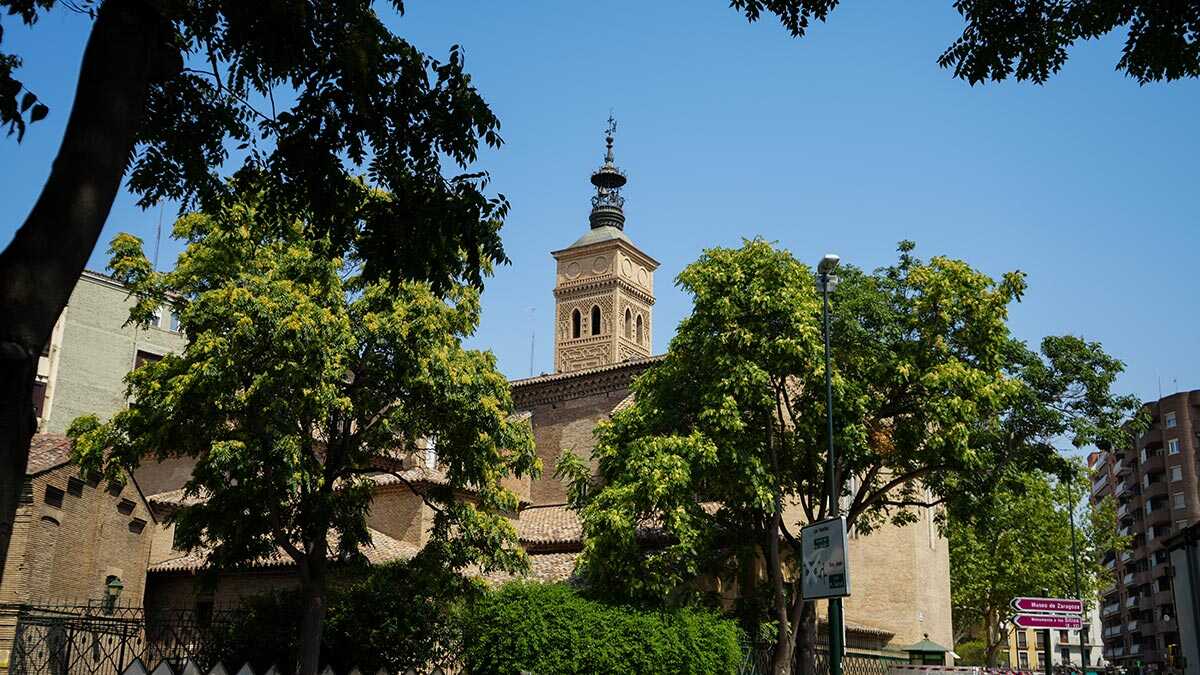
The tower of San Miguel de los Navarros rises on the rooftops of Zaragoza with a silhouette that is difficult to confuse. The brick of its Mudejar construction gives way, as the gaze ascends, to one of its most unique elements: an iron spire that crowns the complex and that keeps a history closely linked to the city. There is the one known as the Bell of the Lost, whose sound served for centuries to guide those who tried to return to Zaragoza among the darkness and fog.
The temple that stands today next to the Plaza de San Miguel is also the result of centuries of transformations. Its origin is linked to a primitive hermitage built after the conquest of Zaragoza by Alfonso I in 1118 and, later, the Gothic-Mudejar construction of the fourteenth century arrived. Renaissance reforms, a profound Baroque transformation and different contemporary restorations ended up shaping the church that has survived to the present day.
Much of that history can still be read in its architecture, but there is one area that remains far from the usual gaze. The tower cannot be visited, according to Fernando Fernández, a member of the heritage commission of the parish of San Miguel. Inside and at the top are preserved some of the keys to understanding the evolution of this jewel of Aragonese Mudejar and a tradition that continues to live every night.
FROM A HERMITAGE AFTER THE CONQUEST TO A JEWEL OF THE MUDEJAR
The history of San Miguel de los Navarros begins long before the construction of the building we know today. According to the documentation provided by Fernando Fernández, from the parish heritage commission, its origin is found in a hermitage built after Alfonso I conquered Zaragoza in 1118.

Tradition even relates the name of the temple to that episode. A large part of Alfonso I’s troops were Navarrese and would have attacked the city through the sector where the church was later built. According to the story transmitted by the parish, a miracle of San Miguel would have made the victory possible and, in gratitude, that first hermitage dedicated to the archangel was built. Hence the name of San Miguel de los Navarros.
The growth of Christian Zaragoza would end up completely transforming that environment. San Miguel was located outside the old stone wall, in the southeastern sector of the city, between this defense and the later brick and rammed earth fence. Urban development gave rise to the so-called Ensanche de San Miguel, in a process comparable to that experienced by the parish of San Pablo.
The great transformation came in the fourteenth century, when the Gothic-Mudejar temple was built. The church was then smaller than today’s, with a single nave and a polygonal apse, following a model that had similarities with the nearby church of Santa Catalina.
A MUDEJAR TOWER THAT HAS CHANGED FOR CENTURIES
The tower also comes from that medieval period. Historical documentation states that in 1396 the masters Stevan Ferrer and Pascual Ferriz acquired bricks and calcin from Gil Pérez Del Put. Its original structure was made up of three bodies and presented an abundant decoration made of the brick itself.

The first was a smooth body; the second was divided into two floors decorated with brick reliefs, with mixtilinear arches on pilasters in the lower area and diamonds in the upper area. The third body corresponded to the bells and was also divided into two open levels. The tower originally ended in a crenellated parapet and a pyramidal spire, a historical appearance that came to be captured in the perspective of Zaragoza made by Anton van den Wyngaerde.
The geometric motifs are not limited to the tower. In the fourteenth-century apse there is a large upper brick frieze composed of reliefs of pilasters and rhombuses. There are also squares next to the windows with flowered crosses, elements present in other Mudejar churches such as those of Azuara or Herrera de los Navarros.
«The tower retains a good part of its original structure and you can still see the characteristic decorative elements of Aragonese Mudejar, such as brick reliefs, diamonds and glazed ceramics,» explains Fernando Fernández.
THE SPIRE THAT FOREVER CHANGED THE SILHOUETTE OF SAN MIGUEL
You have to look up quite a bit to discover another chapter in the history of the monument. The top that currently crowns San Miguel does not belong to the medieval construction. In 1898, the architect Ricardo Magdalena Tabuenca and the master tinsmith Santiago Fau made the unique modernist spire that today characterizes the silhouette of the tower.
The structure starts from a truncated copper pyramidal base that functions as the roof of the bell body. On top of it rises a wrought iron framework covered with floral, vegetal and linear decoration. The documentation highlights Magdalena’s ability to integrate the iron architecture of the nineteenth century with the traditional Mudejar language of the building.
And it is precisely in this space where one of the great protagonists of the popular history of San Miguel is located: the Bell of the Lost. A bell whose function was for centuries much more important than simply marking the hours.
THE BELL THAT PREVENTED THE ZARAGOZANS FROM DYING IN THE FOG
To understand its origin, it is necessary to imagine a very different Zaragoza. Fernández explains that in 1505, on the other side of the Huerva River, there were no houses, but trees and forest. The day laborers went out to collect firewood to sell later in the city and had to return through a territory that during winter nights could become a trap.

The fog could become so thick that some lost their bearings. According to the history preserved by the parish, one January, when the gates of Zaragoza were opened, two dead women appeared after not having managed to find their way back.
The city then looked for a way to prevent that from happening again. The first solution was to install a lighthouse at the top of the church of San Miguel so that its light would serve as a reference for those who remained outside the walls during the night. However, that signal did not last forever: in 1556 a storm tore it up.
The answer was to replace light with sound. It was decided to ring a bell every half hour during the night. Their tolls pierced the darkness and allowed the lost to orient themselves towards Zaragoza. A kind of «sound beacon» had thus been born, a reference that could be heard even when the fog made it impossible to distinguish any point on the horizon.
33 CHIMES THAT STILL RING EVERY NIGHT
Zaragoza ended up growing beyond its ancient walls. The fields surrounding San Miguel were occupied by streets and buildings and that orientation function was no longer necessary. The tradition, however, survived.
«The city was urbanized but the tradition of the Bell of the Lost continued for centuries,» says Fernández. And even today there remains a small memory of that function that the tower had when the night Zaragoza ended much earlier than where it does today.
Every night, at 10:05 p.m., the Bell of the Lost continues to ring 33 symbolic bells, according to information provided by the parish’s heritage commission. A sound that no longer needs to guide day laborers through the fog, but that keeps alive one of the most curious episodes linked to the church.
FROM THE GREAT BAROQUE REFORM TO THE RESTORATIONS OF THE TWENTIETH CENTURY
The medieval tower cannot be understood without the numerous transformations experienced by the rest of the church. In the sixteenth century a period of enlargements began. In 1517 Gil Morlanes and Alí Morisco were hired to carry out works that were to maintain the appearance of the old part of the temple. Two years later, in 1519, Damiá Forment was hired to make the Main Altarpiece.
The most important reform began on April 26, 1666, when the Board of Works signed the capitulation with Juan de Marca, Gaspar Bastarrica and Pedro Cueio. By 1669 the general works were finished. The old vaults of the nave were replaced by barrel vaults with lunettes, although the medieval ribbed vault from the fourteenth century was preserved in the chevet. The side chapels were also transformed to create a smaller nave and the complex was enriched with plasterwork.
The Baroque façade was another of the great novelties. Its composition included a semicircular entrance, pilasters, a classical entablature and a central niche with a monumental representation of Saint Michael fighting the devil, attributed by Antonio Ponz to the artist Gregorio de Mesa.
The following centuries left their mark again. Between 1971 and 1978, Fernando Chueca Goitia proposed two intervention projects in San Miguel. Among the actions that were carried out were the liberation of the apse and the north façade from added constructions, a new metal roof for the central nave and the restorationof the large shell of the Baroque façade.
Subsequently, between 1986 and 1996, Jesús Heredia Lagunas intervened to restore the bell body to its primitive dimensions by means of a reinforced concrete structural solution anchored to the resistant core of the tower’s brick walls.
Thus, the church of San Miguel de los Navarros is today the result of more than eight centuries of accumulated history. From the tradition of that first hermitage built after the Christian conquest to the Mudejar of the fourteenth century; from the baroque to the modernist iron of Ricardo Magdalena. And at the top there is a bell that recalls a time when listening to San Miguel in the fog could mean something as simple and transcendental as finding the way back home.
![[EN] The church of Zaragoza that still guides the lost with 33 bells every night](http://www.disenoaragon.es/wp-content/uploads/2026/08/2026082111455662310-150x150.jpg)
![[EN] The church of Zaragoza that still guides the lost with 33 bells every night](http://www.disenoaragon.es/wp-content/uploads/2026/08/2026082112031835000-150x150.jpg)