There are places where silence is not only the absence of noise, but another part of the landscape. Lonely roads, mountain passes, extensive pine forests and small villages separated by kilometres of nature accompany the traveller on this journey through the interior of Teruel. Hence, the name Puertos del Silencio seems tailor-made for a route in which for long stretches there is hardly anything between the driver and the mountain.
The Puertos del Silencio Route enters the Maestrazgo and the Gúdar-Javalambre region following roads that wind between mountain ranges, ravines, millstones and narrow valleys. Here the journey itself is part of the experience: driving slowly allows you to discover medieval villages perched on the rock, castles, walls and some of the most spectacular natural spaces in the province.

There are 247 kilometers and about four hours and 43 minutes of non-stop driving, although doing them in one go would be precisely against the spirit of the route. The recommendation is to distribute the route in three stages, stop in its villages and take advantage of the viewpoints and natural spaces that appear next to the road.
The itinerary crosses a territory marked by the mountains of Maestrazgo and the Sierra de Gúdar, where dense pine forests give way to moorlands, ravines and huge rock walls. A wild landscape that helps to understand that feeling of isolation and tranquility that gives the route its name.
A ROUTE BETWEEN SOME OF THE MOST BEAUTIFUL VILLAGES IN TERUEL
One of the possible starting points is Mora de Rubielos, whose town centre has been declared a Historic Site. Its large castle-palace dominates the town from above and is one of the best examples of civic-military Gothic architecture preserved in Aragon.

From there, the road continues towards Alcalá de la Selva and Gúdar, in the heart of the mountains. Then Allepuz, Villarroya de los Pinares and Fortanete appear, towns where you can still find palaces, churches, old stately homes and numerous examples of traditional architecture.
The route becomes especially spectacular as you enter the Maestrazgo. Cañada de Benatanduz and Villarluengo appear between deep ravines and large rocky walls before reaching one of the great natural treasures of the route.
These are the Montoro Organs, a gigantic formation of calcareous needles more than 200 meters high that owes its name to its resemblance to the pipes of an organ. One of the best places to contemplate them is located next to the road itself, in the Collado de Casa Mazuelos.
FROM CANTAVIEJA TO MIRAMBEL, THE MEDIEVAL HEART OF THE ROUTE
Another of the essential points is Cantavieja, located at an altitude of 1,290 meters and surrounded by an abrupt landscape of ravines. Its historic centre preserves a spectacular arcaded Plaza Mayor, the sixteenth-century Town Hall and the Church of the Assumption, among other monumental buildings.
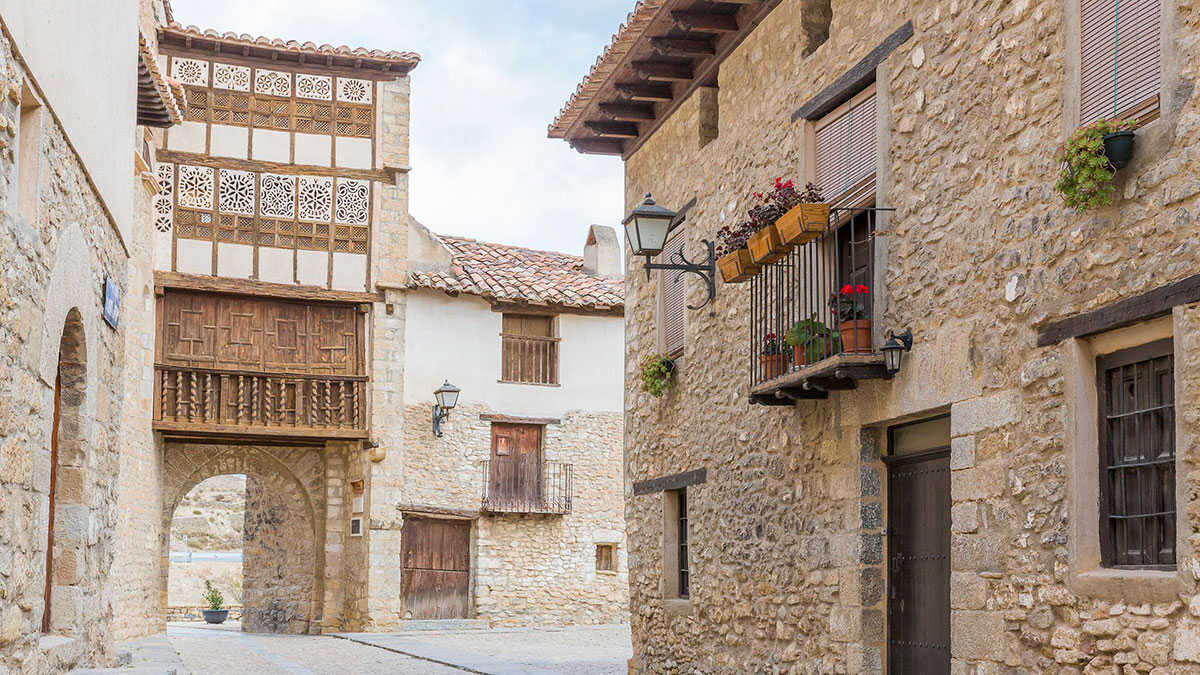
Nearby awaits Mirambel, one of the best-preserved medieval ensembles in Aragon. The population is almost entirely within its walls, between defensive portals, palaces, churches, manor houses and cobbled streets.
The route continues through La Iglesuela del Cid, also known for its landscape of dry stone architecture, and Mosqueruela, located at an altitude of almost 1,500 metres and surrounded by extensive pine forests.

The final section leads to Linares de Mora and Rubielos de Mora, another of the great monumental complexes of the province. Palaces, manor houses, convents and old gates of the wall put the finishing touch to a tour in which heritage and nature advance practically hand in hand.
247 KILOMETERS TO TRAVEL WITHOUT HASTE
Although it could be completed in one day, the Ports of Silence Route is designed precisely to do the opposite. The proposal recommends three stages: Mora de Rubielos-Fortanete, Fortanete-Órganos de Montoro-Cantavieja and Cantavieja-Rubielos de Mora.
A journey on secondary roads where it is worth stopping the car, walking through the villages and contemplating the landscape. Because between the mountains of Maestrazgo and Gúdar-Javalambre, silence is not only the name of the route: it is part of the journey.
![[EN] The 247-kilometre route through Teruel where silence reigns: medieval villages, mountains and unique landscapes](http://www.disenoaragon.es/wp-content/uploads/2026/08/2026082412461498913-150x150.jpg)
![[EN] The 247-kilometre route through Teruel where silence reigns: medieval villages, mountains and unique landscapes](http://www.disenoaragon.es/wp-content/uploads/2026/08/2026030609241611072-150x150.jpg)