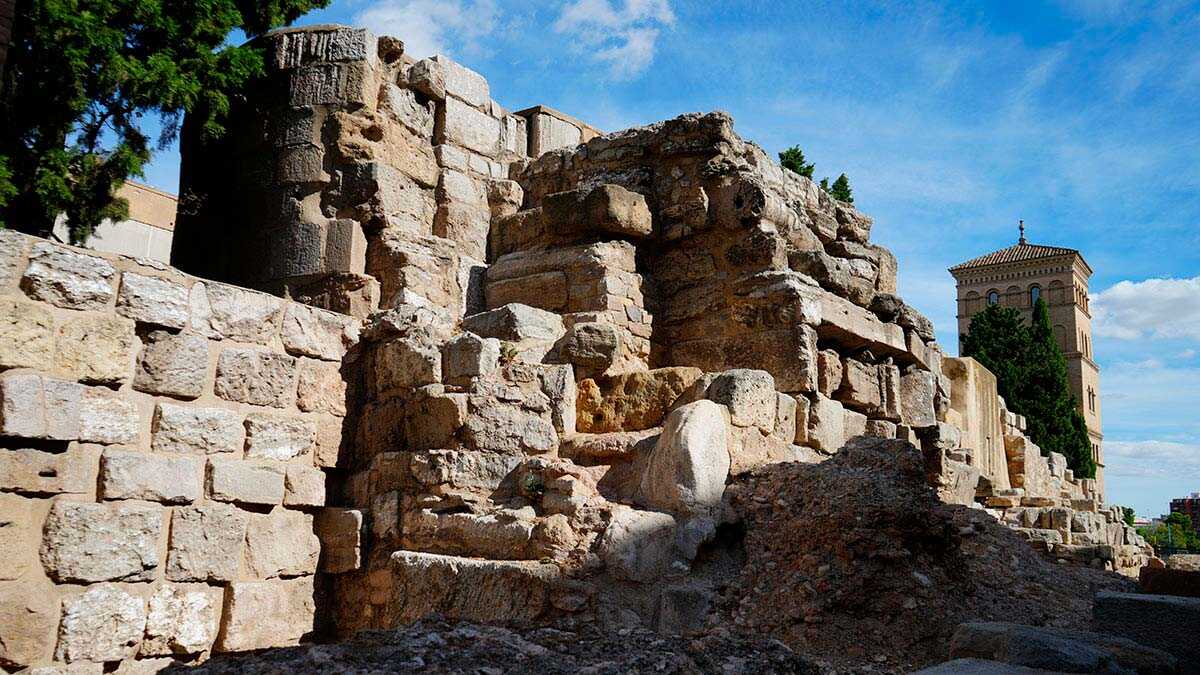
The Aragonese capital preserves under its streets, buildings and basements a part of its Roman past that is not within sight of it. There are 49 remains of the ancient wall of Caesar Augusta that remain in spaces that are not usually accessible and that can now be better known thanks to «The walls of Caesar Augusta: an update», the first monograph of a new collection of the Zaragoza City Council dedicated to the archaeological heritage of the city.
The book offers an up-to-date view of one of the main vestiges of the Roman Zaragoza and combines dissemination and scientific rigour to reach both researchers and specialists as well as the general public.
Among its contents is a map that integrates the preserved remains of the wall, which allows you to observe the complex, learn about the distribution of the towers and approach the proposals on the location of the ancient gates of Caesar Augusta. In addition to the most well-known and visible sections, such as those of La Zuda or San Juan de los Panetes, the publication allows us to focus on this archaeological heritage hidden under the city.
ALMOST 50 YEARS OF URBAN ARCHAEOLOGY
The new monograph brings together the results of archaeological research and interventions carried out over decades and is also a recognition of Zaragoza’s role as a pioneering city in urban archaeology. José Juan Domingo, head of the Heritage Unit of the City Council and coordinator of the publication together with José Francisco Casabona and José Ignacio Royo, explained that since 1981 more than 400 archaeological interventions have been carried out in Zaragoza. However, he considers that there was a deficit when it came to transferring this scientific knowledge to the public, a lack that this new collection aims to cover.

The volume includes a chronology of the wall from its origins to the present day, a section on the regulations that protect this heritage and the results of some of the latest interventions. He also compares the work carried out in Zaragoza with that of the Roman walls of Mérida, Tarragona and Ávila. The study does not close the research: there are currently two other plots of land in Zaragoza where new remains of the wall are being documented that have not yet been incorporated into the book. The publication also maintains the interpretation of the two major known construction phases, the concrete wall and the stone wall.
The Minister of Culture, Sara Fernández, has defended for her part that the conservation of archaeological heritage must be accompanied by its dissemination and has stressed that many of these remains remain hidden because they are under buildings, car parks and other spaces in the city.
Thus, the new collection was born with the intention of publishing a monograph every year and future volumes on San Lázaro, the necropolis, anthropological studies, ceramic materials and other archaeological interventions are already being considered. For now, the first publication will be available from this Wednesday in the municipal museums and in the Municipal Center of Cultural Heritage, in the old Pontoneros Barracks.