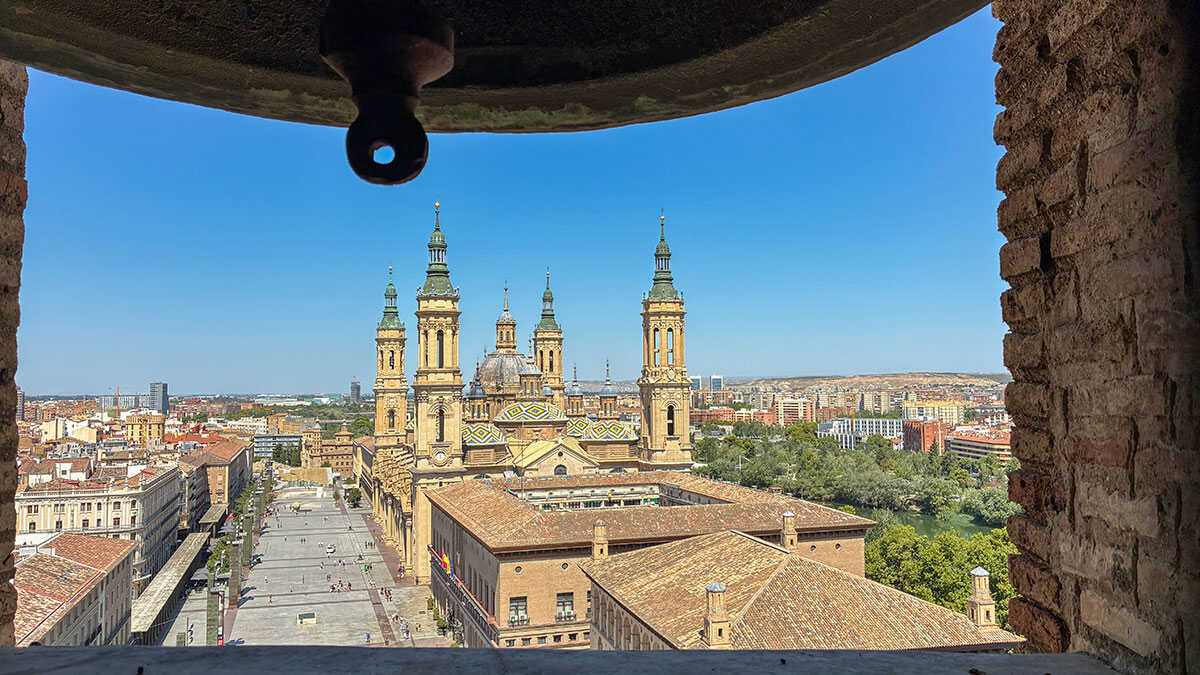
To observe the tower of La Seo from the Plaza del Pilar is to admire one of those silhouettes that seem to have always been there, watching Zaragoza from above. Its baroque profile emerges on the rooftops of the historic centre and marks, together with the towers of the Basilica, the monumental skyline of the city. But have you ever wondered how it came to dominate the heights of Zaragoza? To discover it, you have to look beyond its current appearance and travel to ancient Saraqusta.
The history of the Cathedral of El Salvador is, in fact, the history of Zaragoza built layer upon layer. The building stands in the same space occupied by the forum of Caesaraugusta and, centuries later, the Aljama Mosque or Main Mosque of Saraqusta. After the Christian conquest of 1118, that space was transformed to become the first Christian cathedral in Zaragoza. Work on the Romanesque temple began at the end of the twelfth century and successive extensions ended up giving shape to the extraordinary complex that we see today.
The tower that stands next to the cathedral today, however, is much younger. Its history begins in the seventeenth century and has as its unexpected protagonist La Valera, the great bell of La Seo, whose name comes from < href = "https://www.aragondigital.es/tags/san-valero/">San Valero. A storm damaged the bell and forced it to be dismantled for repairs. When it had to be replaced, they found that the old structure did not offer the necessary guarantees to support it. The old Muslim minaret, converted for centuries into a Christian bell tower, remained until 1683 and gave way to the construction of a new tower.

This is one of the great surprises of the monument. Javier Ibáñez, professor of Art History at the University of Zaragoza, explains that the new tower was built by reusing materialsfrom the old Islamic minaret and resorting to construction techniques of medieval tradition. The alabaster ashlars in its lower part led to the belief for a long time that it was a medieval work, but research points to a new construction that took advantage of old materials and systems. A Baroque tower that, in some way, still preserves the material memory of the Islamic Saraqusta.
THE TRIP TO ROME THAT CHANGED THE TOWER OF THE SEO
Before the new tower began to grow over Zaragoza, its design undertook a surprising round trip to Rome. The Aragonese master Gaspar Serranmade a first proposal that was sent to the Italian capital for study by the architect Giovanni Battista Contini, who introduced modifications in that approach. The Roman project is dated 1683 and the works on the tower began in 1686.

The result was not simply the importation of an Italian design. According to Ibáñez, the plans that came from Rome were put into practice using construction solutions deeply rooted in Aragon. Thus was born a structure formed by two octagons, one inside the other: the tower and the counter-tower. Between them runs the staircase and in the center a huge empty space was left to allow the ascent of La Valera to the bell area.
This construction system also had an important advantage: it allowed the tower to be erected at the same time as the builders themselves ascended, reducing the need for large exterior scaffolding. In this way, the influences of the Roman Baroque ended up merging with traditional construction techniques to shape one of the most recognizable towers in Zaragoza.
The Italian adventure can still be seen on paper. In the archive of La Seo are preserved the great original designs sent by Contini from Rome, documents of around two meters in length that show what the new tower should have been like. There is also documentation related to Gaspar Serrano’s project, testimony of that dialogue between Zaragoza and Rome that ended up transforming the profile of the cathedral forever.
THIS IS THE TOWER OF THE CATHEDRAL INSIDE: FROM THE HOLE OF THE CITY TO THE SPIRE
If on the outside the tower impresses with its verticality, on the inside it reveals the solutions that made it possible to erect it. The tower of La Seo is not open to tourist visits, so its interior remains out of the usual reach of locals and visitors. Behind its walls, the staircase ascends between the two concentric octagonswhile the large central opening recalls the function for which it was conceived: to allow La Valera to be raised to heights.

There continues La Valera, the bell that is at the origin of all this history. Its name recalls San Valero, patron saint of Zaragoza, and its presence allows us to close a circle that began more than three centuries ago: the need to dismantle, repair and reinstall it ended up highlighting the problems of the old structure and triggering the construction of the current tower.
Higher up is another of the most unique corners: the spire, practically under the cross that crowns La Seo and at a point of very difficult access. The original suffered a fire in the nineteenth century after being struck by lightning and was later rebuilt by Averly. In the cathedral’s archive there is even an anonymous drawing dated around 1850 that represents, by hours, how that fire progressed.
From the highest areas of the tower, Zaragoza changes its scale completely: the Plaza de La Seo is at its feet and the historic centre becomes a landscape of roofs, domes and bell towers. It is a privileged perspective, although inaccessible to the tourist visit, from which you can understand the evolution of a tower that brings together in the same place the Islamic past of Saraqusta, the ideas of the Roman Baroque and the Aragonese construction techniques. A history of more than three centuries suspended over the sky of Zaragoza.