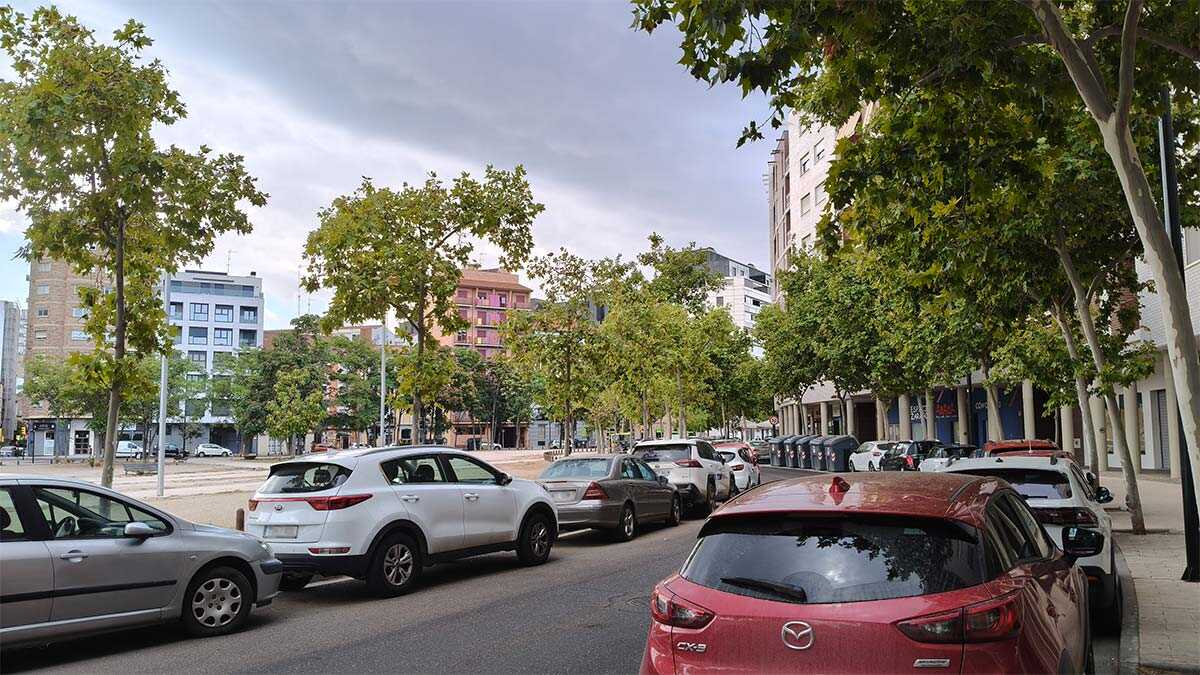
The arrival of the regulated parking at the Arrabal initially generated rejection among the neighbors, but the Tío Jorge Arrabal Neighborhood Association has changed its assessment over time. Its president, Rafael Tejedor, explains that, although at first residents were reluctant to have to pay for parking, they later understood that the measure can help alleviate one of the main problems of the neighborhood: the lack of available spaces.
The reason, according to Tejedor, is that the regulation will allow residents to be prioritised and to favour rotation. In most of the affected areas, the approach contemplates that 80% of the spaces will be for residents and 20% for rotation. The regulated parking will affect everything that is the old part of the Arrabal and approximately 70% of La Azucarera, while there will be a free area in the vicinity of Bielsa street.
For the neighbourhood president, one of the keys is to remove from the street vehicles that remain parked for long periods. A good example of this are, in this sense, work cars and private cars that occupy the same space for days or vehicles that are hardly used and remain parked for months. Regulation, Tejedor argues, can free up these spaces and make it easier for residents to find a place.
EXCEPTIONS ALSO FOR MERCHANTS AND WORKSHOPS
The association also highlights that during the configuration of the regulated parking, merchants and vehicle repair shops have been involved. Tejedor points out that, although they are not residents, these businesses have specific needs, such as leaving vehicles to load goods or carry out repairs, and solutions have been incorporated for these cases.
The implementation of this regulation is part of Zaragoza’s new parking contract, which provides for 4,016 spaces in the Rabal district, 3,444 for residents and 572 for rotation. However, the contract, which will expand the blue and orange zones, is currently suspended as a precautionary measure by the TACPA after an appeal against the award, so its application is pending the court’s resolution.
Regulation, however, is not the only answer for the residents. Tejedor considers it necessary to combine it with the construction of new underground car parks in the vicinity of the esplanade of the Estación del Norte, as well as to study alternatives for areas such as Balsas de Ebro Viejo.
![[EN] El Arrabal faces the blue zone with one objective: to expel the cars that occupy spaces for days](http://www.disenoaragon.es/wp-content/uploads/2026/08/2026082809425519850-150x150.jpg)
![[EN] El Arrabal faces the blue zone with one objective: to expel the cars that occupy spaces for days](http://www.disenoaragon.es/wp-content/uploads/2026/08/2026082810083742773-150x150.jpg)