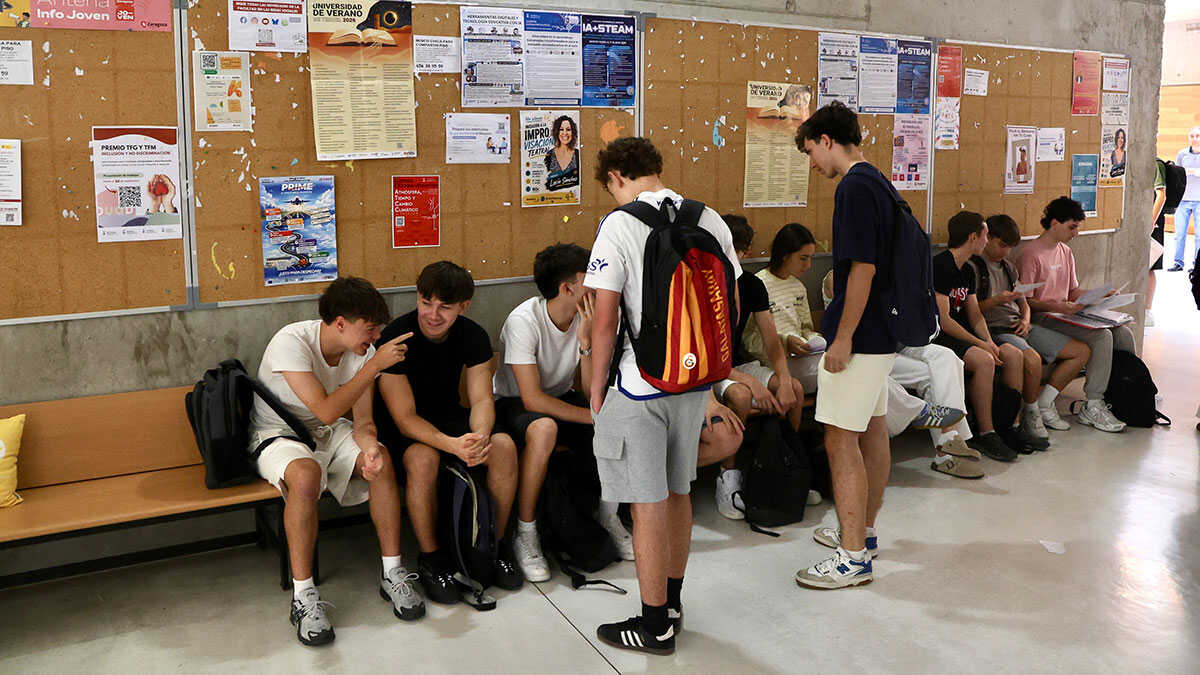
Almost a year ago, the Baccalaureate of Research and Excellence (BIE) was launched for the first time in Aragón at the IES El Picarral de Zaragoza. Although this modality of studies was already present in other Autonomous Communities, fourteen Aragonese students were in charge of premiering this Baccalaureate during the last academic year. Among the students is Daniel Ordóñez, who this year will be in the 2nd year of Baccalaureate, who launched this new adventure in September 2025.
The young man admits that he felt some «uncertainty» the first days of class, since it was a totally new modality, without any reference. «I felt a bit of uncertainty because we would make visits to the University of Zaragoza and that is something I had never seen, it was a new concept. I entered high school with this idea, but in the end everything went very well,» he says.
It is precisely the collaboration with the University of Zaragoza, through a research project, that distinguishes this modality of Baccalaureate from others such as Science. The subjects are the same, but two own subjects are included, one for each year. These are, in the first year, «Initiation to Research«, of a multidisciplinary nature and two teaching hours per week, and, in the second year, the subject «Research Project» with three teaching hours. Both are directed by a professor from the university campus and supervised by a professor from the IES.
As a result of this subject, Daniel remembers that, together with other classmates, they chose to carry out a Physics project. «They gave us a sheet of paper with all the projects we could choose from and we chose a physics project that consisted of identifying plastics using optical measurements,» he explains. As part of this work, they spent six afternoons outside school hours throughout the course in which they went to the Faculty of Sciences of the University of Zaragoza to carry it out.
With the guidance of the tutor of the academic institution, each of these days they were advancing with the project. «He introduced us to the project in general, which is what was going to be done and to the two methods that we used, spectrometry and interferometry. Basically, the tutor guided us and was there in case we had any questions,» says Daniel. Visits to the university have encouraged the young man to choose to study Mechanical Engineering or Physics.
As for the rest of the classes, the student of IES El Picarral recognizes that they deal with concepts «a little more advanced» than in the rest of the Baccalaureates. On the other hand, he believes that being a classroom with few students favors learning: «You understand things much better and you listen to the teacher’s response to other students’ questions. I have never experienced such a concentrated environment.»
After the success of this new modality, the Department of Education has decided to expand this offer for the next academic year 2026-2027, to two more institutes, the IES Medina Albaida, in Zaragoza, and the IES Torre de los Espejos, in Utebo.