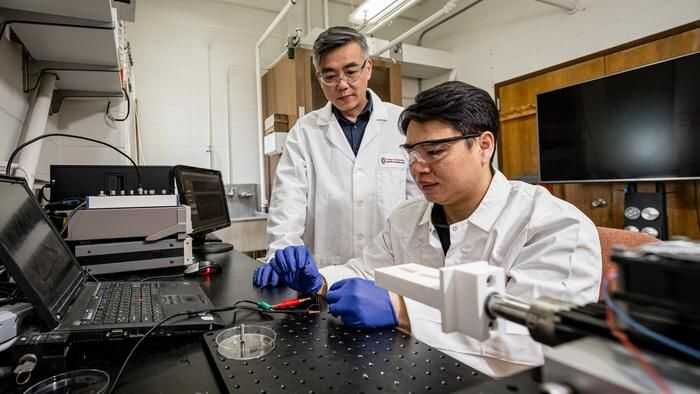
A team of researchers at the University of Wisconsin-Madison (United States) has developed a battery-free implantable pacemaker that is charged by the patient’s heartbeat. This device has the potential to last a lifetime, reducing the risks and costs associated with replacing devices when their batteries fail. The research, led by Pengfei Chen, a postdoctoral researcher in materials science and engineering at the University of Wisconsin-Madison, is published in the journal Science Advances.
«For a device like this, it’s not just about producing energy. Power density is the most important thing. You need to get enough power in a small enough volume,» says Xudong Wang, a professor of materials science and engineering who oversees Chen’s research.
The project is not just a theoretical exercise. Devices powered by these nanogenerators could have a lasting impact on patient well-being.
«This technology is incredibly promising. One of the clinical challenges in managing patients with pacemakers is the need to replace the generator when the battery dies, which involves surgical reintervention,» according to Daniel Modaff, a cardiac electrophysiologist at the University of Washington Hospital and Clinics, who adds, «I long for a world where we can implant a single device that will last a patient’s entire life, and this is a big step towards making that dream come true.»
THE FIRST WITHOUT CABLES
Over the past 70 years, pacemakers — electrical devices that stimulate the heart to correct irregular heartbeats — have evolved from simple, bulky devices that needed to be replaced every few years to small, sophisticated microelectronic devices capable of detecting heart rhythms and adjusting themselves in real time.
For many decades, the transvenous pacemaker, a small, battery-powered device implanted in the chest and connected to the heart by wires inserted into the veins, was the standard treatment.
In 2016, the Micra leadless intracardiac pacemaker hit the market. This small device, contained in a titanium capsule about the size of a large vitamin pill, is inserted through a catheter through the femoral vein into the heart, where it is implanted in the right ventricle. This advanced device allows for faster recovery, reduces complications, and does not require implantation in the patient’s chest.
The intracardiac pacemaker has a major drawback. Its battery accounts for more than half of its size and weight, and it only lasts between 7 and 10 years. Once the battery is depleted, removing the implant from the patient’s heart is difficult, so the expired pacemaker is often left in place when a new one is inserted. This poses a problem for young patients, who may need several pacemaker replacements throughout their lives.
For this reason, researchers are looking for alternatives to power these devices in the long term. They explore a variety of options, from tritium batteries to piezoelectric nanogenerators (which produce electricity by compressing or stretching) and triboelectric nanogenerators (which generate energy when two oppositely charged materials come into contact and then separate). However, so far, none of these tiny devices can produce enough energy to properly power the intracardiac pacemaker.