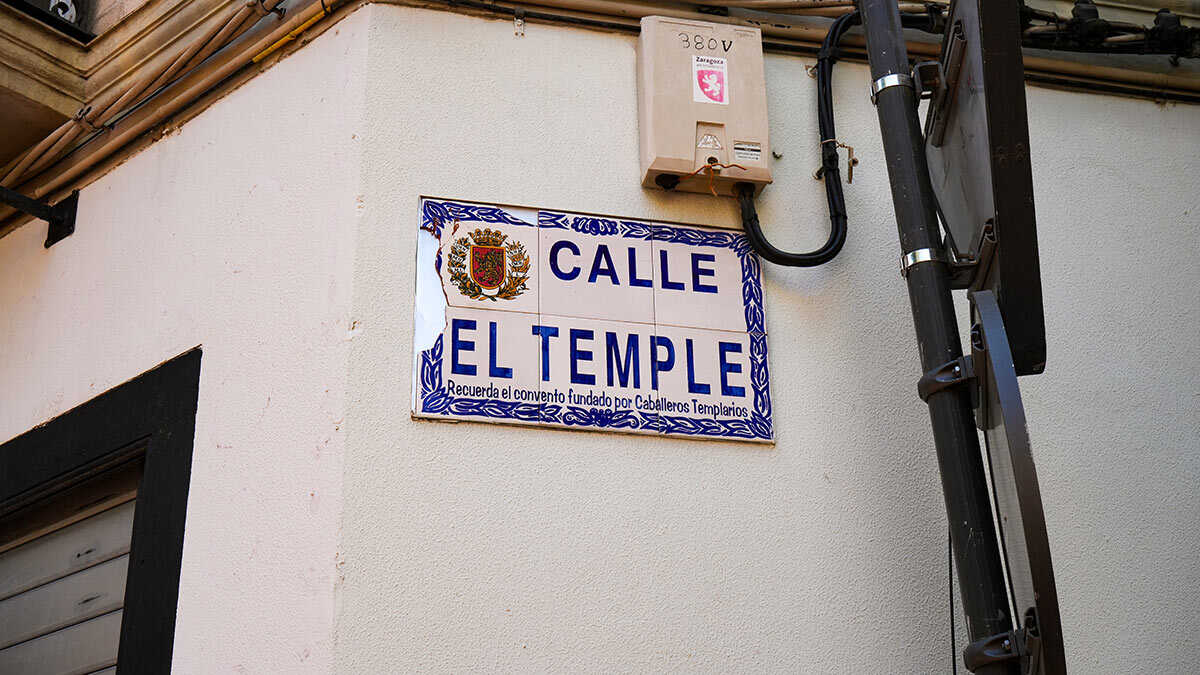
On the corner of Calle del Temple and <a href=»https://www.aragondigital.es/tags/calles/» target=»_blank»>Calle Contamina, in Zaragoza, a seventeenth-century building is still preserved. It is number 14 and stands out for its old stone doorway open in an arch. Today it goes almost unnoticed among those who walk through this area of the historic center of Zaragoza on their way to its bars and bars.
The old church of the Temple of the Aragonese capital, which ended up giving its name to the street, was located a few meters away, on the corner with Santa Isabel street. That unique circular temple was built more than 800 years ago on the remains of a Roman house, where a mosaic was even discovered. A small trace of Roman and medieval Zaragoza that remains hidden under one of the busiest areas of the city centre.

The Templars already had properties in Zaragoza when Ramon Berenguer IV reached an agreement in Girona with Pedro Rovira, dignitary of the Order, so that it would renounce the rights that corresponded to it over the crown by the will of Alfonso the Battler, that king without descendants who had had the idea of bequeathing his kingdom to the military orders of Jerusalem. In exchange, the Templars secured an annual income of 1,000 salaries in the city. In 1148 there is already a Zaragoza commander and by 1164 the encomienda had a convent house in the street. The church and cemetery came later, between the end of the twelfth century and the first years of the thirteenth, confirmed by a document of 1204 between Bishop Ramón de Castrocol and the friars, and by the will of Guisabel, who in 1207 asked to be buried in the cemetery of the Temple.
The temple was circular on the inside and octagonal on the outside, without an apse, an unusual shape that has traditionally been related to the model of the Holy Sepulchre in Jerusalem, although not exclusively. The main entrance opened to the west, from Calle del Temple, and inside there were several chapels, including one dedicated to San Jorge, where Gil Tarín, a knight and merino from Zaragoza, was buried at the beginning of the fourteenth century.
The order did not get to enjoy its church very much. In 1312, Pope Clement V decreed the suppression of the Temple and its assets passed to the Hospitallers of St. John of Jerusalem. The Temple came to an end dragged along by the greed of Philip the Fair of France and the connivance of a papacy that preferred not to ask too many questions.
Neither a photograph nor an engraving of that building is preserved. It only survives drawn on the city plans, as a small circular geometry that was passed from map to map from the beginning of the eighteenth century. José María Quadrado saw it in 1844 converted into an «abject warehouse» and Madoz described it again in 1850 in the same state. It remained standing until 1860 when it disappeared under the pickaxe and a house was built on its site.
That could be the end of the story if it were not for the fact that in October 1991, after the building on the corner of Temple and Santa Isabel was demolished, archaeological tastings were opened led by Francisco Casabona Sebastián and Jesús Ángel Pérez Casas. The complete floor plan of the church appeared and underneath the remains of a Roman domus from the first century, with polychrome geometric mosaic and opus spicatum pavements. It was news for a few days. But a plot of land in the historic center has an owner with construction deadlines, not a museum waiting for visitors, and what came next was a full-blown destruction. The bulldozers eventually destroyed what was left of the circular structure. The medieval walls, in fact, had already been reused a century earlier in the house built after the demolition of 1860. Today the plan of the church is not visible, nor is there a plaque, nor an archaeological window, nor a line on the pavement.
The street remains. No one who passes by will find a sign that there was a Templar church, nor a stone that marks its plan, nor a visible trace of that Roman house. Only the name of the street remains, converted into the last piece of that complex that survived the Templars, the Hospitallers, the confiscations and two centuries of urban transformations.
The church firstappeared in 1860 when it was demolished to build a tenement house in its place. And it disappeared again in 1991, when archaeology made it possible to discover exactly what was under that house and the work ended up erasing what it had just found as well. The street retained the name of the Temple. Del Temple, on the other hand, the street no longer preserves anything.
![[EN] What was a Templar church doing under one of the most famous areas of Zaragoza?](http://www.disenoaragon.es/wp-content/uploads/2026/08/2026082410072781611-150x150.jpg)
![[EN] What was a Templar church doing under one of the most famous areas of Zaragoza?](http://www.disenoaragon.es/wp-content/uploads/2026/08/2026082410371767951-150x150.jpg)