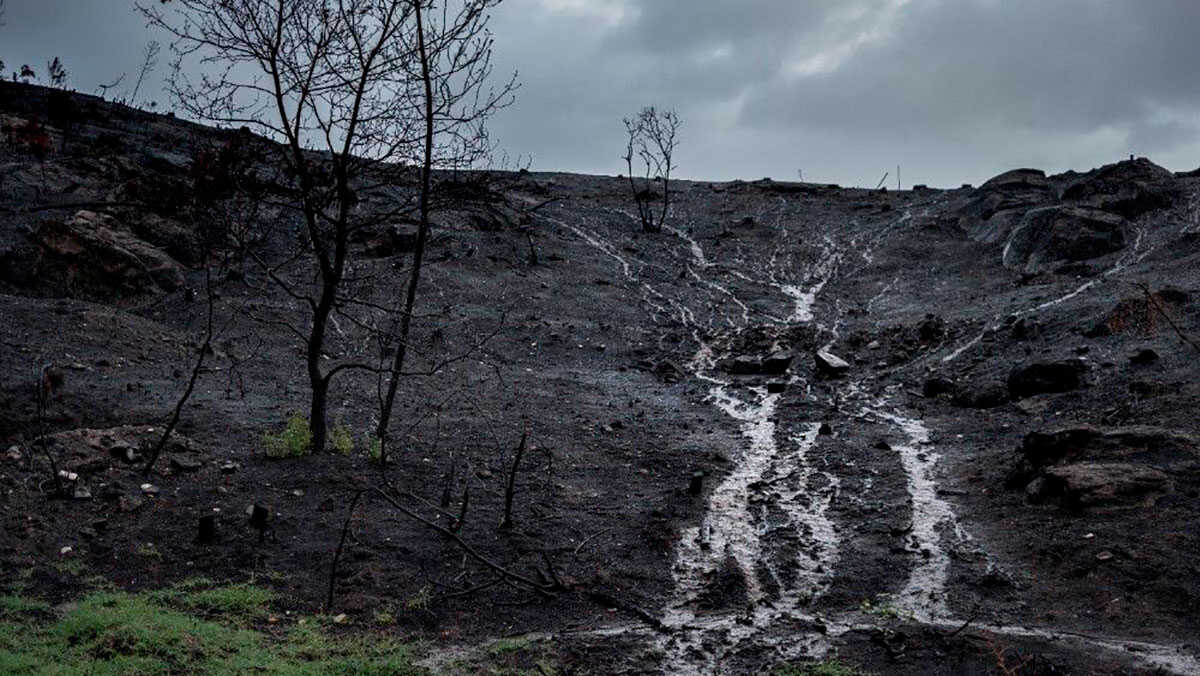
Greenpeace has asked this Tuesday the municipalities affected by the forest fires to start «right now» to prepare emergency actions in the face of a risk that comes after the flames. The environmental organization calls for measures to control erosion and ash dragging and avoid the so-called ‘bush shower’ before the rains appear.
Post-fire precipitation can carry ash, sediment, metals, and other pollutants into rivers, reservoirs, and aquifers. This process compromises the quality of groundwater and surface water and can affect the supply in different municipalities, in addition to causing impacts on aquatic ecosystems, biodiversity and even people’s safety.
A total of 262,030 hectares were burned this year until August 20, according to the Ministry for Ecological Transition and the Demographic Challenge. The 44 large forest fires – that is, when they burn more than 500 hectares – in 2026 have left «records that confirm the evolution of fires to episodes of high intensity due to climate change», according to Greenpeace.
In fact, the one in Burgohondo (Ávila) was the one with the largest area affected in the history of España, the one in Niebla (Huelva) in Andalusia, the one in La Mierla (Guadajara) in Castilla-La Mancha and the one in the Sierra Oeste in the Community of Madrid, while the one in Peñas de Riglos (Huesca) turned out to be the second most destructive in Aragón.
«It is necessary to save water and soil from erosive processes, and we must prevent the scars of fire from generating more impacts on the population and biodiversity. Above all, in the face of increasingly larger and more severe fires,» according to Mónica Parrilla, head of Greenpeace’s fire campaign.
MEASURES TO PROTECT SOIL AND WATER
After a major fire, public debate often focuses on recovery, restoration, costs, etc. For Greenpeace, there is a decisive phase: emergency actions to stabilize the land and prevent the contamination of watercourses, conserve the soil and avoid erosive and irreversible processes of degradation.
«We must remember that soil is a practically non-renewable resource, on which life depends and whose conservation is essential: the FAO estimates that forming just two to three centimeters of fertile soil can require up to 1,000 years, while its loss due to erosion can occur in a very short time,» Parrilla warned.
Among the emergency stabilization measures, those focused on slopes and steep slopes stand out. These actions must prioritise the installation of mulching and other retention structures, such as sashes, dikes and barriers with trunks and branches, correctly designed to stop sediment dragging.
These measures are complemented by the punctual protection of riverbeds, drains and passage works to prevent clogging, as well as with the control of concentrated erosive processes, such as streams, gullies or small landslides.
There is a broad scientific consensus that mulching is one of the most effective post-fire emergency measures to conserve soil, as it significantly reduces erosion and runoff, improves infiltration and accelerates the functional recovery of the ecosystem, especially during the first year after the fire, when the risk of irreversible soil loss is at its highest.
ACTING BEFORE THE FIRST RAINS
According to a study published in 2022, after the great fire in Ponte Caldelas (Galicia), restoration actions carried out by volunteers and coordinated by technical staff proved to be effective in curbing soil degradation. Early mulch reduced erosion by 76% to 95% during the first year after the fire and maintained reductions of between 74% and 87% in the second year.
One of the most recent experiences is that of the Las Médulas fire (León), in 2025, where a report coordinated by the Spanish National Research Council (CSIC) and prepared by more than 70 specialists in fires, biodiversity, geology, hydrogeology, drones and social risks confirmed the effectiveness of early stabilisation actions. Among them is the application of mulch with agricultural straw in the most affected areas, a technique that managed to reduce soil erosion by an average of 85%.
«Given the magnitude of the burned area, we must act where it is most needed and do it in time. Prioritisation must be based on technical criteria, allocating resources to areas with the greatest risk of soil loss, contamination of riverbeds and reservoirs and impact on water supplies, protected areas and areas of high slope,» says Greenpeace.
In this sense, Parrilla stresses: «If we want to avoid the ‘chapapote del monte’, an immediate and specialized response is essential that acts in the first weeks after the fire, when the greatest risk of erosion, runoff and dragging of ash and sediments is concentrated.»
«Stabilization measures must be implemented before the first intense rains, since it is in those first episodes of precipitation that the greatest loss of soil occurs and the most serious impacts on rivers, reservoirs and water supplies are generated,» it adds.
The restoration of areas affected by forest fires is the responsibility of the autonomous communities, which must plan and execute emergency actions to protect the soil, reduce erosion and promote the recovery of ecosystems.
Given that, due to their magnitude, some fires affect several autonomous communities, Greenpeace considered it «essential» to strengthen coordination between administrations with the participation of the central government in the areas of its competence, such as general coordination, technical and financial support, the management of inter-community watersheds or the conservation of areas of national interest.