








Aragon is preparing to experience one of the most important astronomical events of the century. This August 12, 2026, the community will be one of the best places in Spain and Europe to observe a total solar eclipse, a phenomenon that will turn day into night for more than a minute in large areas of the Aragonese territory.
It will be the first total eclipse visible from the Iberian Peninsula since 1912 and the first of an exceptional sequence of three consecutive eclipses that can be seen in Spain between 2026 and 2028, popularly known as the Eclipse Trio. The phenomenon will reach its peak of darkness around 8:30 p.m., when the Sun is already very low above the western horizon, so looking for a high place will be essential to see it correctly.
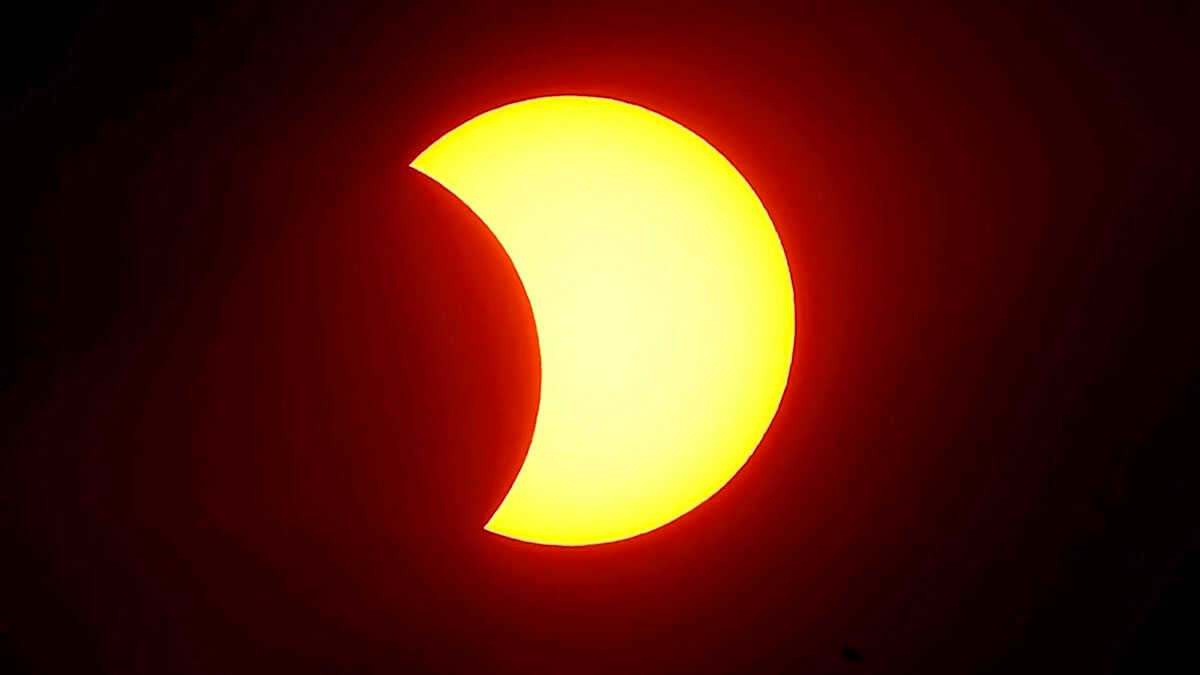
For a few moments, the Moon will completely cover the solar disk and cast its shadow on part of the Aragonese territory, especially in the provinces of Zaragoza and Teruel. The result will be a scene that is difficult to forget: a decrease in luminosity, changes in temperature, unusual behavior of the animals and the appearance of the solar corona, visible only during totality.
WHAT IS A SOLAR ECLIPSE
A solar eclipse is an astronomical phenomenon that occurs when the Moon comes between the Sun and the Earth, totally or partially obscuring the light of the star. For it to happen, the three celestial bodies must align almost perfectly in a straight line, an arrangement known in astronomy as syzygy.
When the Moon’s shadow is projected on the Earth’s surface, two different zones are generated. The umbra is the region where the Sun is completely hidden and where a total eclipse can be observed. Around it is the penumbra, where only a part of the solar disk is covered and the eclipse is partially perceived. For this reason, not all people observe the phenomenon in the same way, even when they are relatively close to each other.
WHERE TO SEE THE SOLAR ECLIPSE IN ARAGON
Aragon will be one of the most privileged communities in Spain to observe the total eclipse. The band of totality will cross a large part of the territory from west to east, allowing the phenomenon to be contemplated in exceptional conditions from numerous towns in Zaragoza and Teruel.
The position of the Sun will be one of the most important factors. The eclipse will occur shortly before sunset, so it will be essential to look for places with a completely clear western horizon. Elevated areas away from obstacles such as mountains, buildings or forest masses will offer the best observing conditions.
Best places to see the eclipse in Zaragoza
The province of Zaragoza will be one of the privileged territories to follow the total eclipse on August 12. Among the most recommended points are the regions of Campo de Daroca, Community of Calatayud and Valdejalón, where the totality will reach some of its longest durations within the province. Towns such as Daroca, Calatayud, Ariza, Ateca, Morata de Jalón, La Almunia de Doña Godina, Cariñena or Épila will start with a very favorable position to observe the eclipse. Also particularly interesting are the natural viewpoints of the Sierra de Vicort or the surroundings of the Gallocanta lagoon, where the visual amplitude of the horizon can facilitate observation.
In the city of Zaragoza it will also be possible to contemplate the totality, although experts recommend staying away from buildings and obstacles that may make it difficult to see the Sun when it is very low above the horizon.
Best places to see the eclipse in Teruel
The province of Teruel will be one of the great epicenters of the total solar eclipse on August 12, 2026. A large part of its territory is located very close to the central line of totality, the area where the phenomenon reaches its maximum duration. For this reason, it will be one of the most popular destinations for astronomers, photographers and amateurs from all over Spain and abroad.
Among the places with the best prospects are municipalities in the regions of Jiloca, Community of Teruel, Cuencas Mineras, Maestrazgo, Andorra-Sierra de Arcos and Bajo Aragón. Towns such as Calamocha, Monreal del Campo, Teruel, Utrillas, Alcañiz, Andorra, Mora de Rubielos, Cantavieja or Valderrobres are among the points with the best conditions to observe the totality. In some areas of these regions, total darkness may last for more than a minute and a half, approaching 103 seconds, one of the longest expected durations in Spain.

Best places to see the eclipse in Huesca
The province of Huesca will be in a more peripheral position with respect to the eclipse’s band of totality. While a large part of the Pyrenees and the north of Huesca will observe a partial eclipse, the best conditions will be concentrated in the eastern and southern end of the province, especially in the Bajo Cinca region.
Municipalities such as Fraga, Velilla de Cinca, Zaidín, Osso de Cinca, Ballobar, Belver de Cinca or Chalamera are among the places in Huesca with the best prospects to enjoy the phenomenon. Its proximity to the strip of totality will allow us to observe a very deep occultation of the Sun and will make this area one of the most interesting points in the province to follow the eclipse.
Official observation points of the Government of Aragon
Given the magnitude of the event, the The Government of Aragon has designed a network of seven large official observation points with a capacity for about 70,000 people.
The main spaces will be located in Calamocha and MotorLand Aragón, in Alcañiz, with a capacity for 15,000 visitors each. There will also be areas enabled in Monreal del Campo, the industrial estate of Épila, Ariza, Cariñena and the Javalambre ski resort.
These enclosures will have sanitary services, Civil Protection, firefighters, shaded areas, informative spaces and giant screens to follow the eclipse in case weather conditions make direct observation difficult.
WHAT TIME WILL THE ECLIPSE BE SEEN IN ARAGON
The eclipse will begin to be visible in Aragon shortly after 7:30 p.m. From that moment, the Moon will begin to progressively cover the solar disk until it reaches the phase of totality.
The phenomenon will coincide with the last hours of daylight, a circumstance that will make the observation especially spectacular, although it will also force you to carefully choose the place from which to contemplate it.
Eclipse schedule in Zaragoza
Zaragoza will be one of the Spanish capitals from which the total solar eclipse can be seen. The phenomenon will begin at exactly 7:34:35 p.m., when the Moon begins to hide a small part of the solar disk. From that moment on, the coverage will increase progressively for almost an hour.
The most spectacular phase will arrive at 8:28:57 p.m., at which time totality will begin. For 1 minute and 23 seconds, the Sun will be completely hidden by the Moon and the city will experience a darkness unbecoming of an August afternoon. Totality will end at 8:30 p.m., giving way to the gradual return of sunlight.
The eclipse will continue to be visible until 9:07:35 p.m., just a few minutes before sunset. For this reason, it will be essential to look for locations with a completely unobstructed view towards the western horizon so as not to miss any of the phases of the phenomenon.
Eclipse schedule in Teruel
The province of Teruel will enjoy one of the most complete experiences in all of Spain. The eclipse will begin at 7:36:50 p.m. and will progressively advance until it reaches the totality phase at 8:30:59 p.m.
Total darkness will last for 100 seconds, that is, 1 minute and 40 seconds, one of the longest times that can be enjoyed in the country. During this interval, the Sun will disappear completely from the sky and it will be possible to contemplate unique phenomena such as the solar corona, Baily’s pearls or the diamond ring.
Totality will conclude at 8:32:33 p.m., while the eclipse will not completely end until 9:05:54 p.m. The combination between the duration of totality and the position of the Sun near the horizon makes Teruel one of the most coveted places to observe the eclipse of August 12.
Eclipse timetable in Huesca
In Huesca, the eclipse will begin at 7:33:45 p.m., becoming one of the first Aragonese capitals to observe the beginning of the phenomenon. From that moment on, the Moon will progressively cover the Sun as the afternoon progresses.
Unlike Zaragoza and Teruel, the capital of Huesca is outside the band of totality, so there will not be complete darkness. Even so, the eclipse will achieve a very prominent occultation of the solar disk and will cause an evident reduction in ambient luminosity.
The phenomenon will end at 9:06:41 p.m., practically coinciding with sunset. As in the rest of Aragon, choosing an elevated place with a clear western horizon will be key to following the eclipse until its last moments.
When will be the moment of maximum darkness of the eclipse in Aragon
The most awaited moment, the moment of maximum darkness of the total solar eclipse will arrive between 8:29 p.m. and 8:32 p.m., depending on the place of observation.
It will be then that the Moon completely covers the Sun and the sky experiences a sudden darkening. During those seconds you will be able to see such spectacular phenomena as the solar corona, Baily’s pearls or the well-known diamond ring.
HOW TO VIEW THE SOLAR ECLIPSE SAFELY
Safety will be one of the keys to the eclipse. Looking directly at the Sun without adequate protection can cause irreversible damage to the retina even if much of the solar disk is covered by the Moon.
For this reason, experts insist on the need to use only approved observation systems. Aragon will also distribute thousands of special glasses and Infant and Primary school children will receive certified devices to follow the phenomenon safely.
There is one basic rule that every observer should remember: approved glasses must be worn during all partial phases of the eclipse. That is, from the moment the Moon begins to cover the Sun until it is completely hidden. They should also be put back in immediately after totality, as soon as the first flash of sunlight reappears.
The only exception occurs during the phase of absolute totality, when the solar disk is 100% covered by the Moon. In those short seconds or minutes it is possible to remove the glasses and contemplate the solar corona directly. However, as soon as the well-known diamond ring or any small point of sunlight appears, it will be essential to protect your eyes immediately again.
What glasses are used to see the eclipse
The only glasses suitable for observing the eclipse are those that comply with the international standard ISO 12312-2.

These glasses are specifically designed to filter solar radiation and allow you to safely track the phenomenon during the partial phases. They will also need to be used with cameras, binoculars or telescopes, which will need specific solar filters.
Which glasses don’t work: dangerous errors
Conventional sunglasses do not protect against solar radiation during an eclipse.
X-rays, smoked glass, CDs, photographic negatives, mobile phones or any home method are also useless. Experts remind us that all of them can generate a false sense of security and cause permanent damage to eyesight.
How to watch the eclipse with kids
Minors must wear the same approved glasses as adults and always remain under supervision.
Specialists recommend explaining the phenomenon beforehand and checking that the glasses are in good condition before using them. It is also advisable to use indirect observation methods and attend activities organized by scientific institutions or city councils.

ARAGÓN WILL BE THE CENTER OF THE INTERNATIONAL BROADCAST OF THE ECLIPSE
The importance of the total eclipse of August 12, 2026 is reflected in a decision that places Aragon on the world map of astronomy. The European Space Agency (ESA) has chosen theAstrophysical Observatory of Javalambre, in the province of Teruel, as one of the main scenarios for the international broadcast of the phenomenon. Thanks to this free-to-air broadcast, millions of people will be able to follow the eclipse through ESA’s website and its official YouTube channel.
The broadcast will be hosted by the renowned scientist and space communicator Dame Dr. Maggie Aderin-Pocock and will feature the participation of international experts who will explain live what happens during a total solar eclipse and what their scientific interest is. The programme will also include connections and informative content to bring the phenomenon closer to the general public.
THE TRIO OF ECLIPSES THAT CAN BE SEEN IN SPAIN BETWEEN 2026 AND 2028
The total eclipse on August 12, 2026 will not be an isolated event. It is part of an exceptional sequence of astronomical phenomena that many experts have already baptized as the «Iberian trio of eclipses», a unique combination that will allow three outstanding eclipses to be observed from Spain in just three consecutive years.
The series will begin with the total solar eclipse on August 12, 2026, which will have Aragon as one of its main protagonists. A year later, on August 2, 2027, another total eclipse will cross the Iberian Peninsula, although the band of totality will especially favor southern Spain. Finally, on January 26, 2028, an annular solar eclipse will arrive, in which the Moon will not completely cover the Sun and will leave the spectacular «ring of fire» visible.
The coincidence of three eclipses of these characteristics in such a short period is extremely rare. In fact, to find a similar sequence you have to go back many decades. For this reason, scientific bodies, observatories and public administrations have been preparing informative activities and special programmes for years to bring these phenomena closer to the general public.