








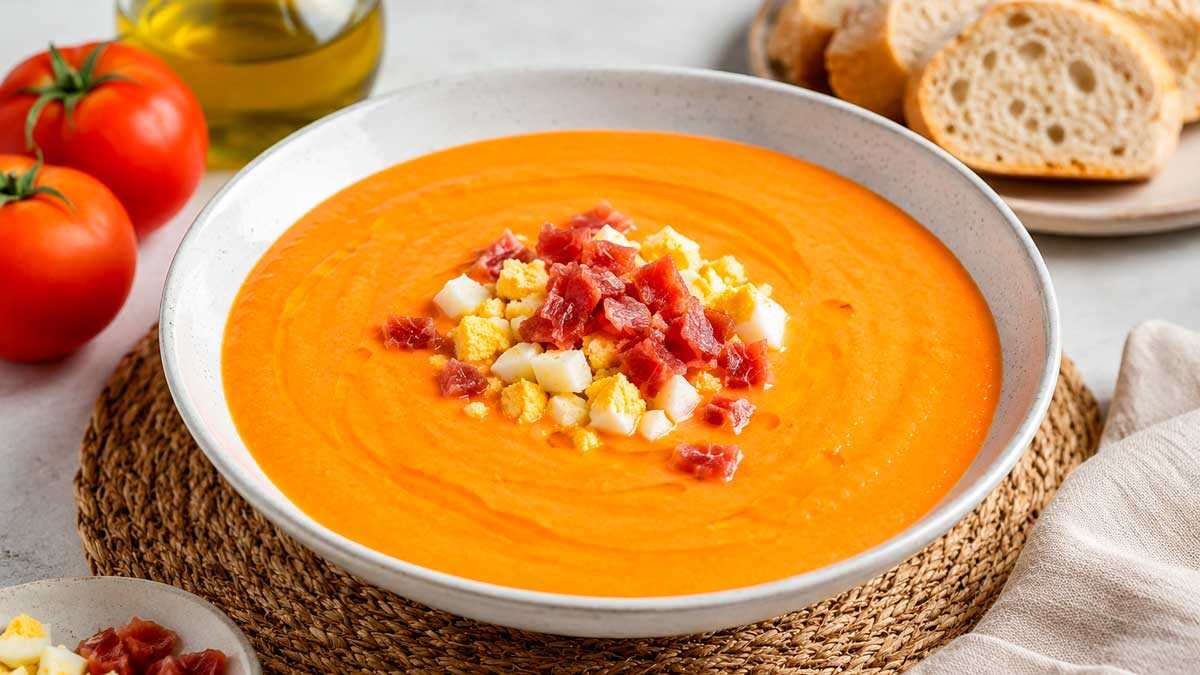
With the heat of summer, many choose to have a carton of salmorejo in the fridge to solve a quick meal without giving up a fresh dish. However, not all of them taste the same or cost the same. The Organization of Consumers and Users (OCU) has analyzed 30 refrigerated salmorejos sold in supermarkets and has detected important differences in taste, labeling and price, although all obtain a good nutritional rating. The tasting also leaves a striking conclusion: the best valued salmorejo costs only 3 euros per liter, compared to more than 8 euros per liter of the most expensive product in the analysis.
The study explains that these products are an interesting option to incorporate into the diet during the summer months thanks to their nutritional profile. The main differences between some references and others appear in the tasting test carried out by a panel of expert chefs, in addition to the cost and information offered by the labels.
GOOD GRADE IN NUTRITION, BUT NOT EVERYONE RESPECTS THE TRADITIONAL RECIPE
The OCU experts recall that all the salmorejos analysed obtain a good or very good rating on the organisation’s Healthy Scale. The combination of tomato, olive oil, garlic and bread, together with the absence of industrial additives, makes these products an interesting alternative for a fast food during the summer.
The entity explains that they provide vitamins and minerals, have a high nutritional density and, in many cases, even have fewer calories than a homemade salmorejo, as they tend to incorporate less bread and a smaller amount of olive oil. On the other hand, they contain less fibre because the vegetables are peeled and go through different filtering processes during processing.
The analysis also warns that some manufacturers add red pepper or bell pepper to soften the acidity and enhance the color, as well as onion and vinegar to promote preservation. These are ingredients that are not part of the traditional recipe and that, according to the tasting, tend to harm the final result. In some cases, the product is closer to a gazpacho than to a salmorejo. The experts also detected small traces of breadcrumbs, sometimes with a slight rancid taste.
THE BEST-RATED SALMOREJOS ACCORDING TO THE OCU
The tasting was carried out with the products at room temperature to better appreciate their aromas and nuances. The salmorejo from La Huerta de Don Simón, with a price of 3 euros per litre, obtained the best rating from the panel of experts. It was followed by Hacendado (3 euros per litre), Dia Al Punto (2.99 euros per litre) and RealFooding, whose price ranges between 3.52 and 4.37 euros per litre.
The study highlights that several of the best-rated products have contained prices, which shows that it is not always necessary to pay more to find a quality salmorejo.
DIFFERENCES OF UP TO SIX EUROS PER LITRE
Price is another aspect where the greatest differences appear. Eroski’s carton salmorejo costs 2.11 euros per litre, while the one made bySanta Teresa with Raf tomato reaches 8.16 euros per litre, almost four times more.
The organization considers that the brik format, especially in the private labels available in supermarkets such as Mercadona, Eroski or Dia, offers a very competitive quality-price ratio. In fact, several of these products equal or even exceed in tasting others that are much more expensive, marketed in transparent bottles or half-litre containers.
In Aragón, where these chains have a large presence, the conclusions of the analysis can serve as a reference for those looking for a quality salmorejo without spending more than necessary.
THE OCU RECOMMENDS COMPARING BEFORE BUYING
The organization encourages you to review the ingredients, nutritional contribution and price before choosing a refrigerated salmorejo. He also notes that many labels are still up for improvement, as in some cases they don’t include the percentage of the main ingredients, the Nutri-Score value, or the manufacturer’s contact information.
To facilitate the choice, the OCU recalls that the free OCU Market application allows you to consult the nutritional assessment of each product, check its content in saturated fats, sugars, salt and additives, as well as compare prices in different establishments using the barcode or the name of the product.