








Not all roads are designed to reach the destination as soon as possible. Some invite you to slow down, take a detour to small villages and enjoy the scenery. That is the philosophy of Slow Driving Aragón, an initiative that brings together some of the most attractive secondary roads in the Community to discover its natural, cultural and historical heritage without haste.
One of these proposals is the «Route of the Ebro, Goya and vestiges of the war», a 212-kilometre route through the province of Zaragoza that connects the place where Francisco de Goya was born, one of the best-known scenes of the Civil War, important archaeological sites, a Cistercian monastery and the Sea of Aragon.

Divided into three stages, the route can be completed in just over three and a half hours, although the experience invites you to stop frequently. From Campo de Belchite to Mequinenza, the itinerary follows the course of the Ebro for a good part of the route and crosses villages linked to the river, old hydraulic infrastructures, medieval monuments and landscapes that help to understand the history of Aragon from different moments in its past.
FIRST STAGE: FROM FUENDETODOS TO FIFTH
The journey begins in Fuendetodos, 44 kilometres from Zaragoza. The town is known throughout the world for being the place where Francisco de Goya was born in 1746. His birthplace, rebuilt after the damage suffered during the Civil War, recreates the appearance of an eighteenth-century rural house and preserves furniture, everyday objects and documentation about the painter. Nearby are the Museum of Engraving and the old refrigerators, where for centuries the snow that turned into ice was stored to supply Zaragoza.

The road then leads to Belchite, a town forever marked by the Civil War. There are two villages separated by just a few meters. The new one, built from the fifties, and the old one, whose streets and churches remain as a testimony of the battle of 1937. Walking among the ruins of the churches of San Martín or San Agustín, the Clock Tower or the convent of San Rafael allows you to understand the historical dimension of one of the most visited places in Aragon.
The next stop on the way comes in Azaila, where the Cabezo de Alcalá is located, considered one of the most important Iberian sites in Aragon. The tour of this ancient city allows you to discover how different cultures coexisted for centuries before the definitive arrival of Rome.
The first stage ends in Quinto, a town located between the Ebro valley and the steppes of Zaragoza. On the headland that dominates the municipality stands El Piquete, an old Mudejar church included in the Unesco world heritage that during the Civil War was used as a defensive position. Inside opens the Museum of the Mummies of Quinto, the first of España dedicated to this type of finding, with a collection of mummified bodies from the eighteenth and nineteenth centuries.
second stage: following the course of the ebro
From Quinto, the Ebro River becomes the main protagonist of the journey. The first stop is Velilla de Ebro, where the remains of Lepida Celsa, an ancient Roman colony founded in 44 BC, are preserved. Its cobbled streets, mosaics and buildings give you an idea of what a Roman city was like built next to the Via Augusta.

The road continues towards Alforque and Alborge, two small municipalities where the Ebro completely changes its appearance. The riverbed runs between high escarpments and gives rise to the well-known embedded meanders, one of the most striking landscapes of the Ribera Baja del Ebro. For centuries, these towns depended on the river to communicate by boats, irrigate the fields or move flour mills. Old dams, waterwheels, mills and jetties are still preserved that remind us of this close relationship with water.
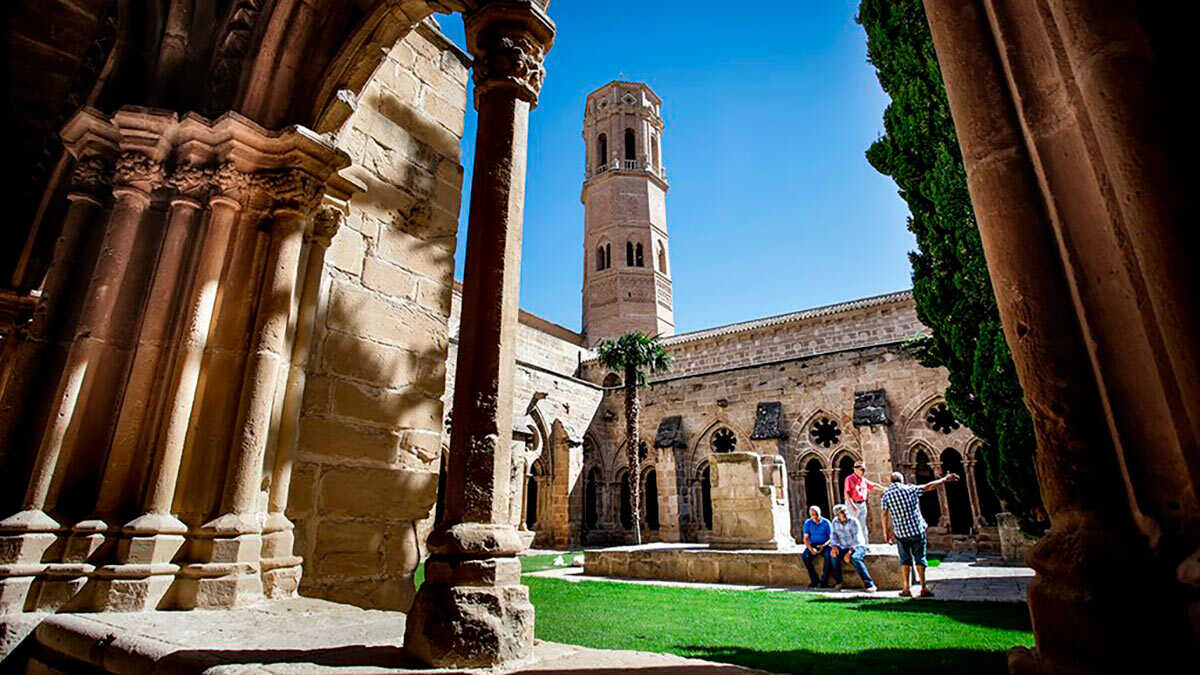
The great protagonist of this stage is the Royal Monastery of Nuestra Señora de Rueda, in Sástago. Founded by the Cistercian Order at the beginning of the thirteenth century and declared a National Monument in 1924, it is one of the best-preserved monastic complexes in Aragon. The church, the cloister, the monumental Ferris wheel next to the Ebro and the old mill show the importance that this monastery had for centuries as an economic and agricultural engine of the entire region.
Before leaving this part of the route, it is also worth stopping at Escatrón and Chiprana. The first preserves a large part of the heritage linked to the monastery and an outstanding Baroque church. The second, known as the Bride of the Ebro, overlooks the Sea of Aragon and allows you to discover the Lagoon Complex of the Saladas de Chiprana, a unique nature reserve for its salt lagoons.
third stage: from caspe to mequinenza
The last stage begins in Caspe, the scene of the historic Compromise of Caspe, which in 1412 decided the succession to the Crown of Aragon. Its collegiate church of Santa María la Mayor, the remains of the Castillo del Bailío and the historic centre remind us of the importance of the town during the Middle Ages. In addition, the nearby Mequinenza reservoir has made the municipality one of the great Aragonese destinations for sport fishing and nautical activities.
Those who have more time can take a detour to Maella and Fabara. In the first await the medieval castle of the Pérez de Almazán family and the birthplace of the sculptor Pablo Gargallo. In the second, the Roman Mausoleum stands out, considered the best preserved in Spain, as well as a fortified church and several museums dedicated to local heritage.
The route then enters Fayón, a town whose history was marked by the construction of the Ribarroja reservoir. The old village disappeared underwater and the new nucleus was built in a different location. From the viewpoint of the hermitage of the Virgen del Pilar you can still see the tower of the old church and the remains of the castle emerging over the reservoir. The municipality also preserves trenches and a museum dedicated to the Battle of the Ebro.
The route ends in Mequinenza, where the Ebro, Segre and Cinca rivers converge. The castle dominates the landscape from the top of the mountain and offers one of the best panoramic views of the Aiguabarreig, an enclave of great environmental value, known for the number of bird species it hosts. At the foot of the fortress is the current town centre, while the Mine Museum and the Museum of History and Prehistory help to learn about the mining past and the evolution of a town that has always been linked to water.
SLOW DRIVING ARAGÓN: TRAVEL WITHOUT HASTE
Slow Driving Aragon is an initiative that brings together different routes on secondary roads to discover the heritage, landscapes and villages of the Community from a different perspective. The itineraries are designed to travel the territory calmly, away from the main roads and the rush.
Its philosophy is summed up in one of its mottos: «When your destination is the road itself«. The aim is to make the journey part of the experience, with time to stop at viewpoints, enjoy the local gastronomy or discover corners that are usually off the beaten track.
Aragon is one of the best places to practice this way of traveling thanks to the diversity of its panoramic roads. In a few kilometres it is possible to go from high mountain landscapes to canyons, deserts, forests or extensive plains, crossing charming villages and unique natural spaces.