








Aragon is preparing for one of the biggest changes in the sale of canned beverages in recent years. There is less than a month left for the Packaging Law, or Regulation (EU) 2025/40 on packaging and packaging waste, to come into force on 12 August, which will begin to implement the Deposit, Return and Return System (SDDR) throughout Spain). The measure will transform the way bottles, cans and other containers are sold in bars, restaurants and supermarkets in the Community. It is not a tax, but a small deposit that consumers will pay when buying certain containers and that they will recover in full when they return them empty at the authorized points.
The implementation of this system responds to Spain’s failure to meet the packaging collection targets set by the European Union. In 2023, only 41.3% of single-use plastic bottles were recovered, a far cry from the 70% required by Brussels. In addition, EU regulations progressively raise this target to 77% in 2025, 85% in 2027 and 90% in 2029, so the Government has activated the DRS to improve recycling rates and avoid possible penalties.
Although the entry into force is set for August 12, its implementation will be progressive and will gradually be extended throughout the country to facilitate the adaptation of manufacturers, distributors, supermarkets and hospitality establishments.
HOW THE NEW SYSTEM WILL WORK AND HOW MUCH MONEY CAN BE RECOVERED
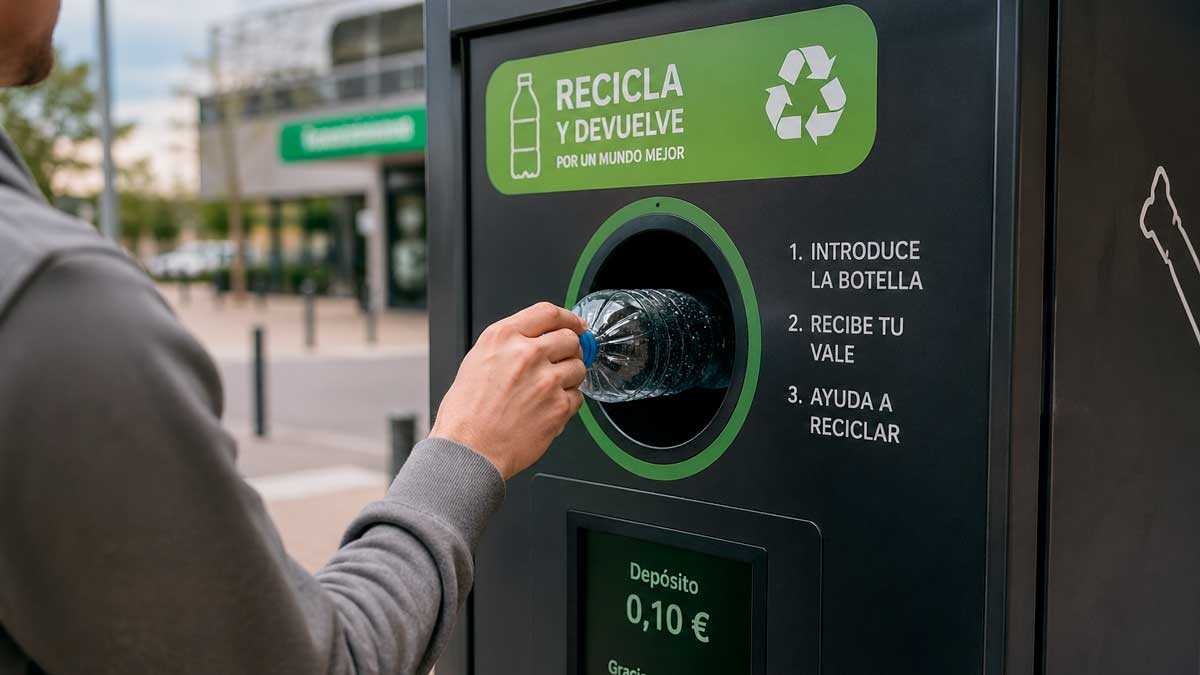
The Deposit, Return and Return System will affect single-use plastic bottles of up to three litres, beverage cans and certain cartons. From the implementation of the system, the consumer will pay a deposit of at least 10 cents for each container, an amount that will be broken down on the purchase receipt.
This amount will not be a final cost. Once the product has been consumed, the customer may return the empty container at one of the points set up and recover the deposit paid in full. To do this, it will be necessary to preserve the packaging in conditions that allow its identification and subsequent recycling.
Supermarkets will incorporate automatic machines to collect packaging, while other establishments will be able to return them using manual systems. In the case of bars and restaurants, the adaptation will also be progressive and they must be integrated into the new system as its implementation progresses.
The aim is to significantly increase the selective collection of packaging and reduce the presence of abandoned waste in the environment, following the model that has already been operating for years in countries such as Germany, Finland, Norway and, more recently, Portugal.
HOW IT WILL AFFECT BARS, SUPERMARKETS AND MANUFACTURERS
The entry into operation of the SDDR will mean a major change for the entire beverage production and distribution chain. Manufacturers, packers, distributors and shops will have to adapt their processes to integrate a new packaging collection and return circuit, as well as modify aspects related to logistics, labelling and warehouse management.
Supermarkets will have to enable systems to accept the return of bottles, cans and other containers included in the regulations, while small businesses and hospitality establishments will have to adapt to the new model as its implementation progresses. This transition will be carried out in stages to facilitate the organization of the sector and avoid problems during the first months of operation.
With this measure, Spain seeks to increase recycling rates, move towards a more circular economy and meet the environmental objectives set by the European Union, which require 90% of this packaging to be collected by 2029. For Aragon, the new Packaging Law will also mean a change in the consumption habits of citizens and companies, which will have to incorporate the return of packaging as a further step in the purchase and recycling process.