








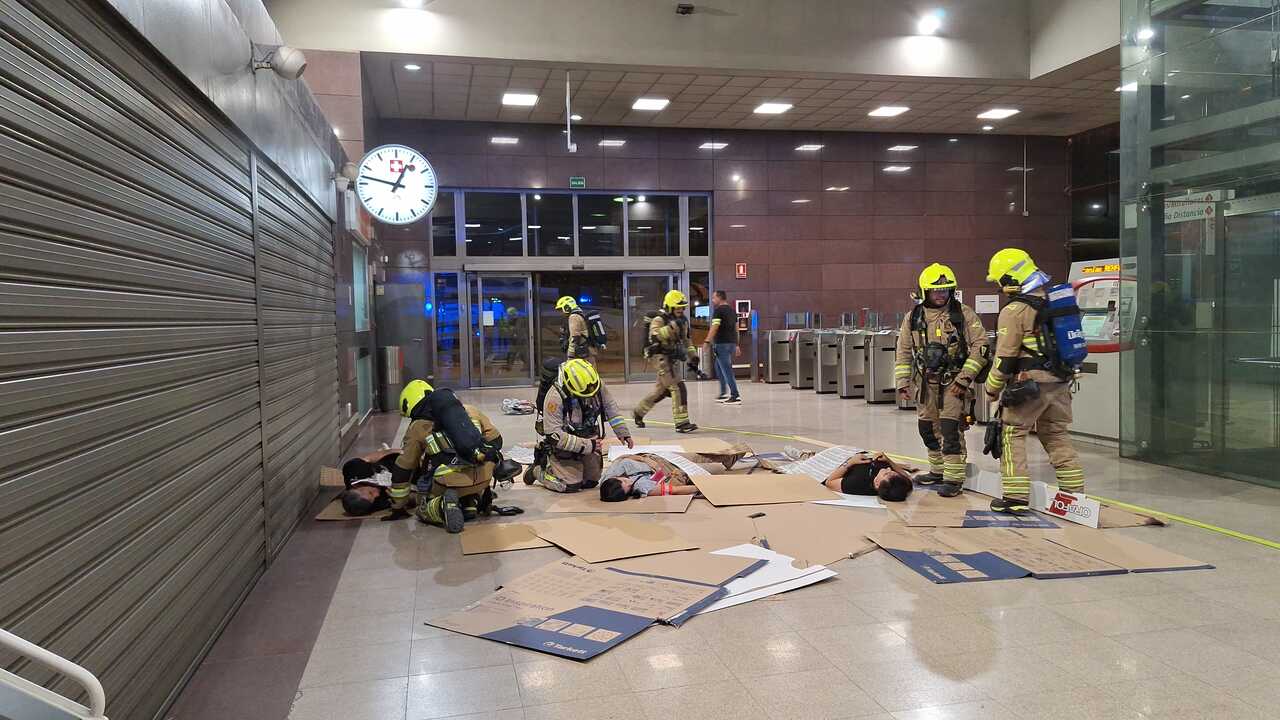
A fire, the collapse of part of the roof and six injured have activated this morning a large emergency device at the Portillo station in Zaragoza. However, what seemed at first glance to be a spectacular accident at one of the Renfe Cercanías stations, was a drill organised by Renfe and Adif to check the response of the teams, evaluate the terminal’s Emergency Plan and improve coordination between the safety and health services of Aragón.
The action began early Friday morning, after a fire was detected at Zaragoza Portillo station that affected a room located in the lobby. In addition, part of the roof has collapsed. In this fictitious event, six injuries of different consideration have been registered. Given the impossibility of attending to the situation with the resort’s own resources, level 1 of the Emergency Plan has been activated and the established protocols have been applied, which include the request for external aid.
Thus, in the drill, in addition to Renfe and Adif, the 112 Aragón has intervened; Firefighters, National and Local Police and Civil Protection of Zaragoza; staff from 061 Aragón, and technicians from the Zaragoza consistory. The staff of the station and the director of the Emergency Action Plan have also participated. Communications have been coordinated through Renfe’s 24-hour Security and Emergency Centre in Valencia, the Zaragoza Commuter Management Centre and Adif’s Protection and Security Centre.
The different teams have coordinated according to the established protocols to transfer the injured to health centers and to evacuate those who were on the platforms through the emergency exits of the Portillo station. Renfe has recalled that the surroundings of the station are currently under construction and with some accesses cut off, which has exceptionally conditioned the actions and has meant that the teams had to adapt their procedures to this circumstance.
FROM ALARM TO RETURN TO NORMALITY
This technical drill at the Portillo station in Zaragoza has been carried out to fine-tune the station’s Emergency Plan and evaluate its different phases: alarm, intervention, evacuation and return to normality.
The last part focused on a meeting of the Technical Committee and the representatives of the intervening bodies to evaluate the exercise in the heat of the moment, with the aim of drawing conclusions that improve coordination in the event of an emergency. The action will make it possible to determine and reinforce the strengths of the Emergency Plan and to know the areas of possible improvement.
Renfe, with the collaboration of Adif, periodically carries out this type of drill to train internal teams and to evaluate their preparedness, the effectiveness of action plans and coordination and leadership in emergencies between the participating bodies. These exercises also make it possible to establish collaboration protocols that guarantee an effective response to emergencies.