









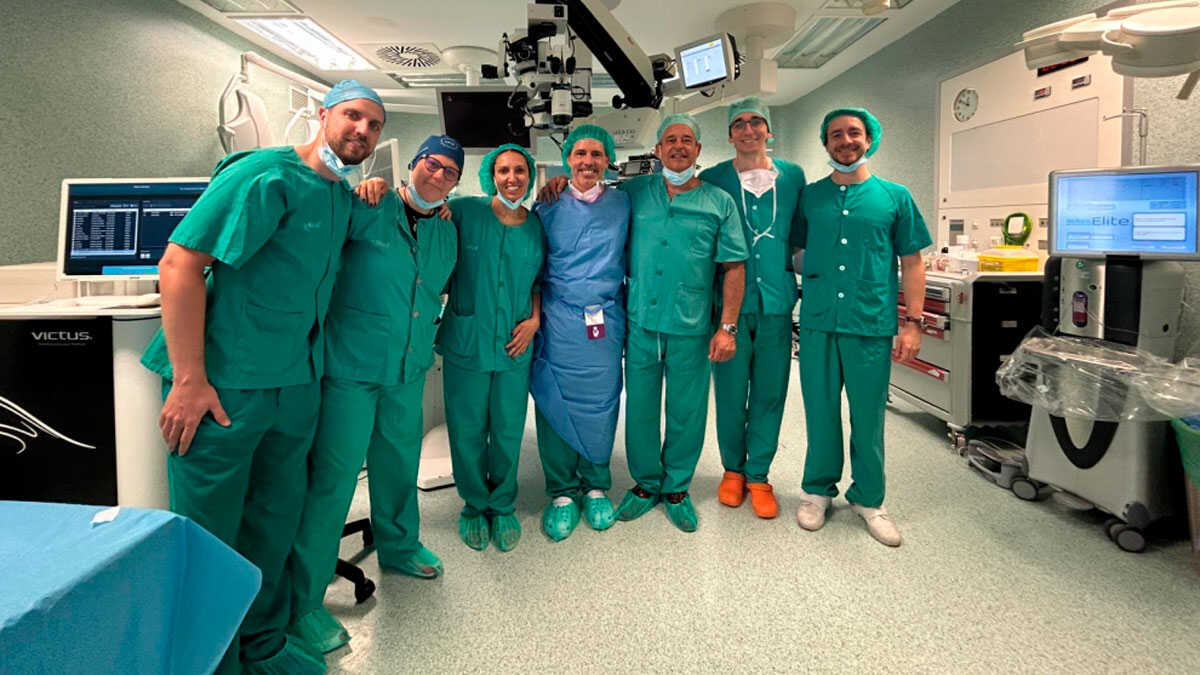
The Hospital Universitario Miguel Servet de Zaragoza has taken another step forward in ophthalmological surgery by successfully performing the first femtosecond laser-assisted corneal transplant in Aragón. The Ophthalmology Service has carried out this intervention with the Victus® system (Bausch + Lomb), a technology that allows for more precise and personalised surgery and represents an important advance for corneal surgery at the centre.
The operation was carried out on Tuesday, July 14, by doctors Antonio Mateo and Víctor Mallén, with the collaboration of the Ophthalmology operating room team, and concluded with an excellent clinical result. «At Servet we have performed the first cornea transplant with femtosecond laser in Aragon,» says ophthalmologist Víctor Mallén. «This technology,» he adds, «allows us to have greater precision in cuts, reduce sutures and increase the safety of the procedure. An innovative advance that is here to stay.»
MORE PRECISION AND FEWER SUTURES
The incorporation of this technology allows corneal cuts to be made with very high precision in both the donor and recipient cornea. This improves the fit between the two tissues and expands the surgical possibilities in the different types of corneal transplants.
As explained by Dr. Antonio Mateo, ophthalmologist at the Miguel Servet University Hospital, «the femtosecond laser allows usto perform much safer, reproducible techniques adapted to each patient. We can design the type of cut and the type of transplant in a personalized way, achieving more reliable and precise procedures.»
One of the main advantages of this technology is its ability to execute perfectly programmed and reproducible cuts, making the surfaces of the donor and recipient cornea fit together with great accuracy. «We can make the donor and recipient tissue fit together pretty much like the pieces of a puzzle. This better adaptation of the edges allows us to reduce the number of sutures needed,» says the specialist.
Conventional penetrating corneal transplants typically use about 16 stitches. With the help of the femtosecond laser, that number can be reduced by about half, which promotes greater stability of the surgical wound and can contribute to faster and more predictable visual recovery in selected patients.
real-time image-guided surgery
The system used incorporates optical coherence tomography (OCT) technology, which allows the cornea to be visualized in real time during the intervention. As a result, surgeons can accurately determine the depth, size, and shape of each cut before and during surgery.
«We no longer work only manually. We can see exactly where we want to cut and to what depth, which allows us to design each intervention with extraordinary precision and personalize it to each patient,» explains Dr. Mateo.
This ability is especially useful in lamellar transplants, in which only certain layers of the cornea are replaced. In these procedures, precision is critical to avoid complications and preserve the patient’s healthy tissue.
In addition to complete corneal transplants, femtosecond technology improves the safety of procedures in which only specific layers of corneal tissue are replaced.
«There are transplants that require working with extremely thin thicknesses. When these preparations are made manually, microperforations can occur that force the planned surgery to be modified. With this technology we increase precision and improve the chances of completing the procedure as planned,» says the specialist.
The use of laser also allows each intervention to be adapted to the anatomical characteristics of each patient, since no two corneas are exactly alike.