









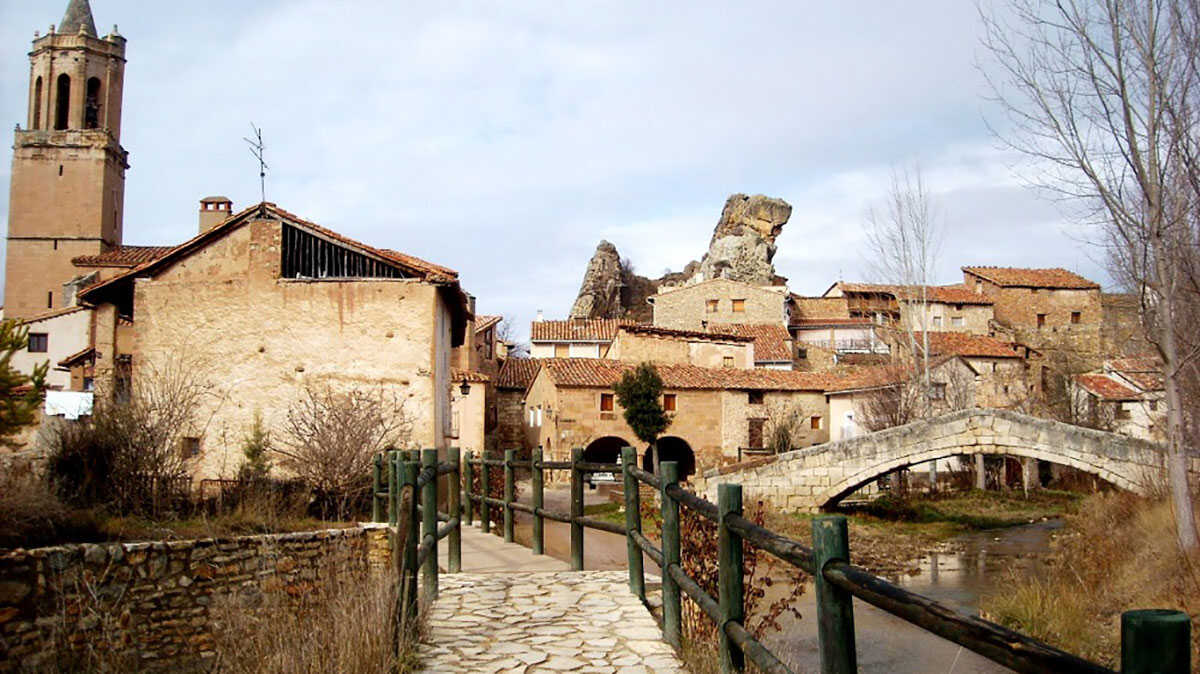
The usual thing when trying to promote tourism in a town is to mention its great monuments, its multitudinous festivals or its historical events. However, Miravete de la Sierra, in 2008, turned everything established on its head and rose to fame under the slogan «the town where nothing ever happens». This small municipality of the Maestrazgo of Teruel carried out a campaign in which its tranquility and leisurely pace became the main attraction to discover it.
However, you only need to walk more than five minutes through its streets to see that behind that famous slogan there is much more. Miravete de la Sierra preserves one of the best examples of medieval architecture in the province, an urban center declared a Historic-Artistic Site and a natural heritage in which there are from riverside forests to dinosaur footprints.
THIS IS MIRAVETE FROM THE SIERRA, THE TOWN WHERE «NOTHING EVER HAPPENS»
Miravete de la Sierra is located in the western end of the Maestrazgo region, in Teruel. Its municipal area occupies 36.5 square kilometres and borders municipalities such as Aliaga, Camarillas, Villarroya de los Pinares and Jorcas.
The Guadalope River crosses the surroundings of the town and helps to organize an urban nucleus divided into three zones. On the left bank are the central town, perched on top of a rock, and the San Cristóbal neighborhood. On the other side of the river stretches the suburbs.
Most of the historic buildings are concentrated in the central core. There, among narrow streets and traditional buildings, the remains of the castle, the parish church, the Town Hall and different civil buildings appear. The Plaza Mayor and Plaza de la Iglesia bring together a large part of this heritage and preserve examples of popular architecture that have survived to the present day without major transformations.

The old oven, the Cavero house, the Rectory house and the ratchet-market complete an architectural ensemble that allows you to travel through centuries of history without leaving a few streets. It is precisely this combination of monumentality, stone and silence that has made Miravete one of the most unique corners of the Maestrazgo.
WHAT TO SEE IN MIRAVETE DE LA SIERRA
The church of Our Lady of the Snows
One of the buildings that dominates the silhouette of the village is the parish church of Nuestra Señora de las Nieves. It was built in 1574 and combines Gothic and Renaissance elements, with ashlar and masonry as the main materials.
The church has a single nave divided into three sections, star-shaped ribbed vaults and chapels located between the buttresses. Its tower has a square first part and an octagonal upper body for the bells, topped by a conical capital.
One of its most curious elements is access. The façade is located under the tower itself, inside a passageway that continues towards the market of the square and forms a very characteristic bend. Inside, stuccoes and paintings from the early nineteenth century are preserved.
The City Council and the squares
The church and the Town Hall form an urban space in the shape of a «U», an arrangement present in different towns of the Teruel Maestrazgo. In Miravete, in addition, a vaulted passage connects the complex with one of the streets and reinforces the uniqueness of the square.
The City Hall is a two-storey building with a simple appearance. Its façade has a semicircular doorway on the ground floor, while the portico is divided into two wings with several arches supported by columns and decorated capitals.
The bridge of the sixteenth century
Another of the most recognizable corners of Miravete de la Sierra is its stone bridge. Built in the sixteenth century, it rises above the river by means of a single semicircular arch, wide and lowered. Its cobbled pavement serves as access to the central nucleus and forms, together with the Guadalope and the houses of the village, one of the most characteristic images of the town.
On the outskirts there is also the hermitage of San Cristóbal, a masonry construction located on the right bank of the river. It has a single nave covered by a half-barrel vault with lunettes, while its façade seems to belong to an earlier building.
A VILLAGE WITH 67 DINOSAUR FOOTPRINTS
Miravete’s heritage is not limited to its buildings. The municipality has two ichnite sites, both listed as Assets of Cultural Interest, which allow you to follow the trail of the dinosaurs that roamed this territory during the transition period between the Jurassic and the Cretaceous.
In one of the outcrops, the path of several quadrupedal sauropods is preserved, consisting of 67 oval footprints. In the second there are footprints corresponding to both herbivorous dinosaurs and carnivorous species.
Added to this are the poplarsthat grow next to the road that connects Miravete with Villarroya de los Pinares. These trees were periodically pruned to obtain beams for construction, a traditional practice that ended up giving their trunks a wide and twisted appearance. Some specimens reach a perimeter of five meters, measured 1.30 meters above the ground.
A STORY THAT GOES BACK TO THE IRON AGE
Although its current image is closely related to the Middle Ages, the earliest known traces of population are much older. The site of Los Villares preserves remains belonging to the First Iron Age and the Iberian period.
After being conquered from the Arabs by Alfonso I the Battler, Miravete and its surroundings were handed over in 1180 to the commandery of the Temple. Over the centuries, the town was linked to different administrative demarcations, until in 1834 it was constituted as a City Council.
HOW TO GET TO MIRAVETE DE LA SIERRA
The main road to get to Miravete de la Sierra is the A-226, a road that connects this area of the Maestrazgo with both Teruel and Cantavieja. From there you have to take the local road TE-V-8008, whose detour is located near Villarroya de los Pinares.
The municipal website also points out the existence of a bus service that connects the town with Teruel and La Iglesuela del Cid, although it is advisable to check the schedules and frequencies beforehand.
Miravete de la Sierra built his fame by assuring that nothing ever happened there. Today, that absence of noise and haste continues to be part of its attraction, but not the only one. Between medieval streets, vaulted steps, a sixteenth-century bridge and dinosaur footprints, this corner of Teruel proves that, even where apparently nothing happens, there is still much to discover.