









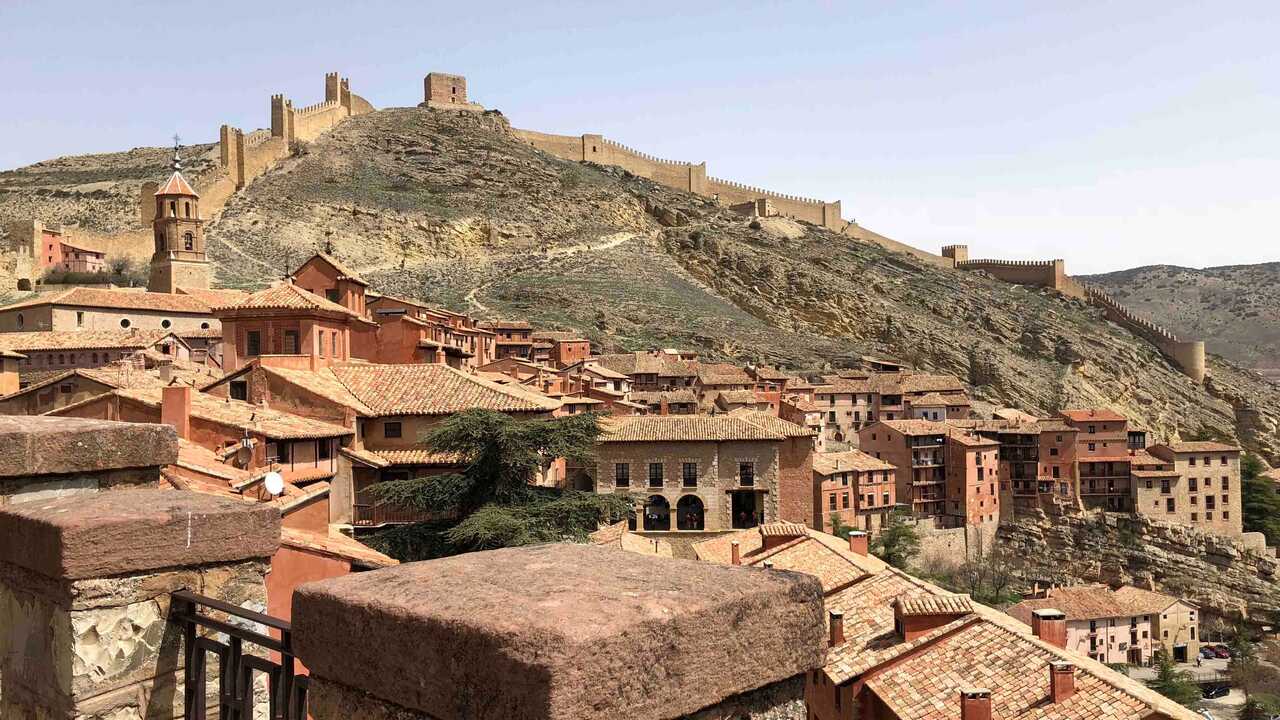
There are few places in Aragón where a total solar eclipse can be seen against a backdrop as recognizable as that of Albarracín. The walls, the houses hanging over the Guadalaviar River and the reddish profile of the town will offer a very different image from other observation points of the 2026 solar eclipse, which on August 12 will leave 93 seconds of total darkness in this corner of the province of Teruel.
The attraction of Albarracín does not lie only in the astronomical phenomenon. Its medieval framework and the surrounding natural viewpoints allow you to turn the day into a getaway to enjoy both the August eclipse and one of the best-known historical sites in Aragon.
THE ECLIPSE FROM ALBARRACÍN
The eclipse will begin in Albarracín at 7:36:44 p.m. with the start of the partial phase. Totality will arrive at 8:30:59 p.m. and will last until 8:32:32 p.m., an interval of 93 seconds during which the Moon will completely hide the Sun. The maximum of the eclipse will be reached at approximately 8:31 p.m., before the phenomenon concludes at 9:07:21 p.m., coinciding with sunset.
The low position of the Sun in those last minutes makes it advisable to look for high places or with a wide panoramic view to the west. The natural viewpoints of the surroundings and the clear areas near the historic centre can become good points for observation, always wearing approved glasses during all the partial phases of the 2026 solar eclipse.
WHAT TO VISIT IN ALBARRACÍN DURING THE GETAWAY
Touring Albarracín means discovering a network of narrow streets, wooden balconies, hundred-year-old gates and reddish facades that preserve the historical character of the town. From the Plaza Mayor you can access some of its main buildings, including the cathedral, the churches of Santiago and Santa María, the Noble House-Museum of the Pérez y Toyuela family, the Municipal Museum, the Diocesan Museum or the Toy Museum.
The walk along the Guadalaviar River allows you to contemplate another perspective of the municipality before entering the Protected Landscape of the Pinares de Rodeno. This space combines pine forests, large reddish rock formations and shelters with Levantine rock art declared a World Heritage Site by UNESCO. A few minutes from the center you can also visit Mar Nummus, the headquarters of Dinópolis dedicated to fossils and ancient prehistoric seas.
To tour the town it is advisable to leave the vehicle in the car parks located at the entrance to the municipality and continue the visit on foot, since much of its charm is discovered by walking through its streets, slopes and staircases.