









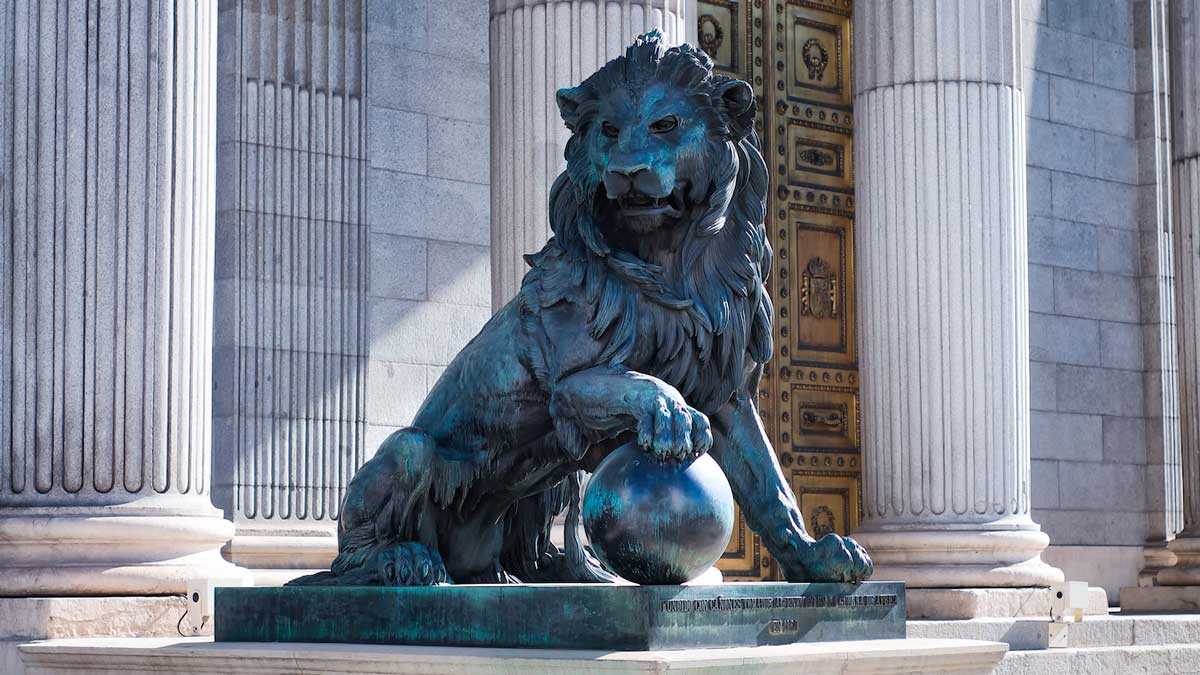
For more than a century, two large bronze lionshave been watching over the entrance of the Congress of Deputies. They have become one of the most recognizable images of Madrid, but their story began in Zaragoza, by the Aragonese sculptor Ponciano Ponzano, who had to overcome two failed attempts before shaping the final couple.
The sculptures, known as Daoiz and Velarde, were not the first to occupy the staircase. Before that, there were two couples who ended up withdrawing because of their lack of resistance or because they did not transmit the strength that the parliamentarians were looking for.
THE FIRST WERE MADE OF PLASTER
The Congress was built on the site of the old convent of the Holy Spirit. Isabel II laid the first stone in 1843 and the building was completed in 1850 under the direction of the architect Narciso Pascual Colomer.
The entrance was initially decorated with two lampposts, but soon the idea of placing two lions arose. Ponzano received the commission, although the lack of budget forced the use of plaster painted with bitumen from Judea to imitate bronze.
The couple opened in 1851, but the rain deteriorated it in a short time. A year later, the figures were practically undone.
The second attempt was made by José Bellver. Their stone lions were also not convincing because of their small size and their unfierce appearance. The people of Madrid baptized them as Benavides and Malospelos and they ended up being transferred to the gardens of Monforte, in Valencia.

THE BRONZE OF CANNONS
The definitive couple came after the African War of 1860. The government decided to use the bronze from the cannons captured from the Moroccan army after the Battle of Wad-Ras.
The material was cast in the Royal Artillery Factory of Seville and Ponzano was once again in charge of the sculptures. The lions were completed in 1865, although they were not installed until 1872 due to the controversy over the metal’s military origin.
Since then, Daoiz and Velarde have guarded the entrance to Congress. Although they look the same, one weighs 450 kilos more than the other. But the most curious thing is that one of them lacks testicles, a peculiarity that has given rise to numerous legends.
THE HISTORY OF THE SCULPTOR FROM ZARAGOZA
Ponzano was born in Zaragoza on January 19, 1813 and grew up surrounded by art thanks to his father’s work as a janitor at the Royal Academy of Nobles and Fine Arts of San Luis.
He trained in Madrid and Rome and in 1845 he was appointed honorary chamber sculptor to Isabel II. He also made the figures of the pediment of the Congress, where an allegory of España embracing the Constitution.
His work also remains in Zaragoza. In the cemetery of Torrero the bust of Juan Bruil is preserved and in the chapel of Santa Ana of the Basilica of El Pilar is the pantheon dedicated to General Manuel de Ena. Ponciano Ponzano died in 1877 in his home studio in Madrid.