There is still the memory of the emotion, the goosebumps and the sensations of the total solar eclipse that experienced much of Spain on August 12. After one of the most anticipated astronomical events in recent years, many are wondering when the next eclipse will be. And the truth is that, although for months there has been talk ofthe famous trio of solar eclipses of 2026, 2027 and 2028, there is another much closer. Specifically, in a week’s time: on August 28, a partial eclipse of the Moon will darken the sky again and can be seen from Spain.
The event will take place during the night of Friday, August 28, 2026. This time it will not be the Sun that momentarily disappears from our view, but it will be a part of the Moon that darkens as it passes through the shadow cast by the Earth. In addition, although the phenomenon will be visible from all over Spain, there will be important differences depending on the place from which it is observed.
WHAT IS A LUNAR ECLIPSE AND HOW IS IT DIFFERENT FROM A SOLAR ECLIPSE
But what exactly happens during a lunar eclipse? This phenomenon occurs when the Earth is located between the Sun and the Moon, so that our planet blocks the sunlight that normally illuminates the satellite and casts its shadow on it. In order for it to happen, the Sun, the Earth, and the Moon have to reach a certain alignment.
The main difference with a solar eclipse is precisely in the position of the three stars. In a solar eclipse, such as the one experienced on August 12, it is the Moon that comes between the Sun and the Earth, totally or partially occulting the solar disk for those who are in certain areas of the planet. In a lunar eclipse, the opposite happens: the Earth is located between the Sun and the Moon and it is its shadow that obscures our satellite.
It also changes the way we look at them. While it is essential to use adequate eye protection to contemplate a solar eclipse, a lunar eclipse can be observed directly with the naked eye and without any risk to the eyes. Therefore, special glasses are not necessary, although binoculars or a telescope can help to better appreciate the advance of the shadow.
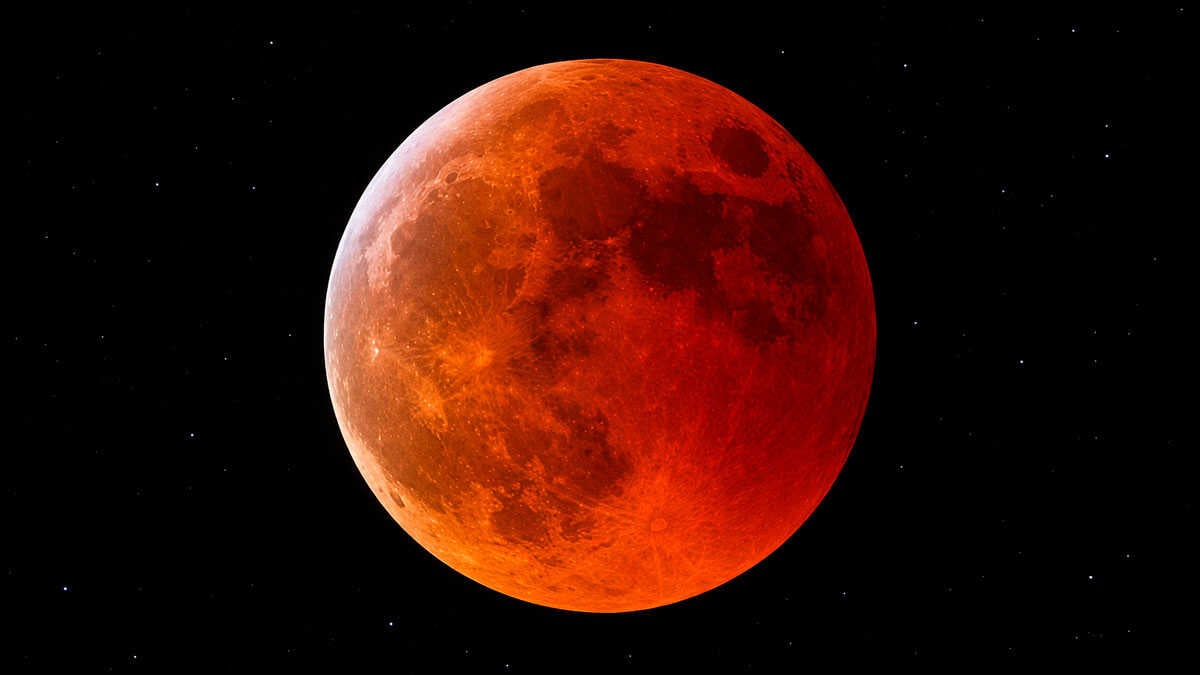
This time we will be facing a partial eclipse of the Moon. This means thatour satellite will not be completely submerged in the darkest part of the Earth’s shadow, but only a part of the lunar disk will be covered. According to data from the National Geographic Institute (IGN), the eclipse on August 28 will have a magnitude of 0.93, so the shadow will reach a very important part of the Moon.
WHERE THE PARTIAL LUNAR ECLIPSE OF AUGUST 28 WILL BE SEEN
The partial lunar eclipse of August 28 can be observed from Spain during the early morning, although its visibility will be very different depending on the area. As a reference, in Madrid the partial phase will begin around 04:34 hours and will reach its maximum around 06:12 hours. However, the Moon will set at around 07:47 hours, a few minutes before the end of the partial phase, scheduled around 07:52.
The best conditions will be in the west of the Peninsula, the Canary Islands and Ceuta, where the Moon will set after the partial phase has ended. This will allow this complete phase to be contemplated. The IGN map shows how much of Galicia, western Castilla y León, Extremadura and western areas of Andalusia will be among the best-placed territories.

On the other hand, inthe centre and east of the peninsula, the Balearic Islands and Melilla, the Moon will set over the horizon before the end of the partial phase. This will also be the case of Aragon, where our satellite will still be hidden within the Earth’s umbra and partially eclipsed, so it will be able to retain its characteristic reddish hue when it is very low above the horizon.
The eclipse will not be exclusive to Spain. According to the IGN, it can be observed in some of its phases from West Asia, Europe, Africa and America. In our country it will be a new opportunity to look at the sky just 16 days after the total solar eclipse on August 12, although this time it will not be necessary to use special glasses to contemplate it.