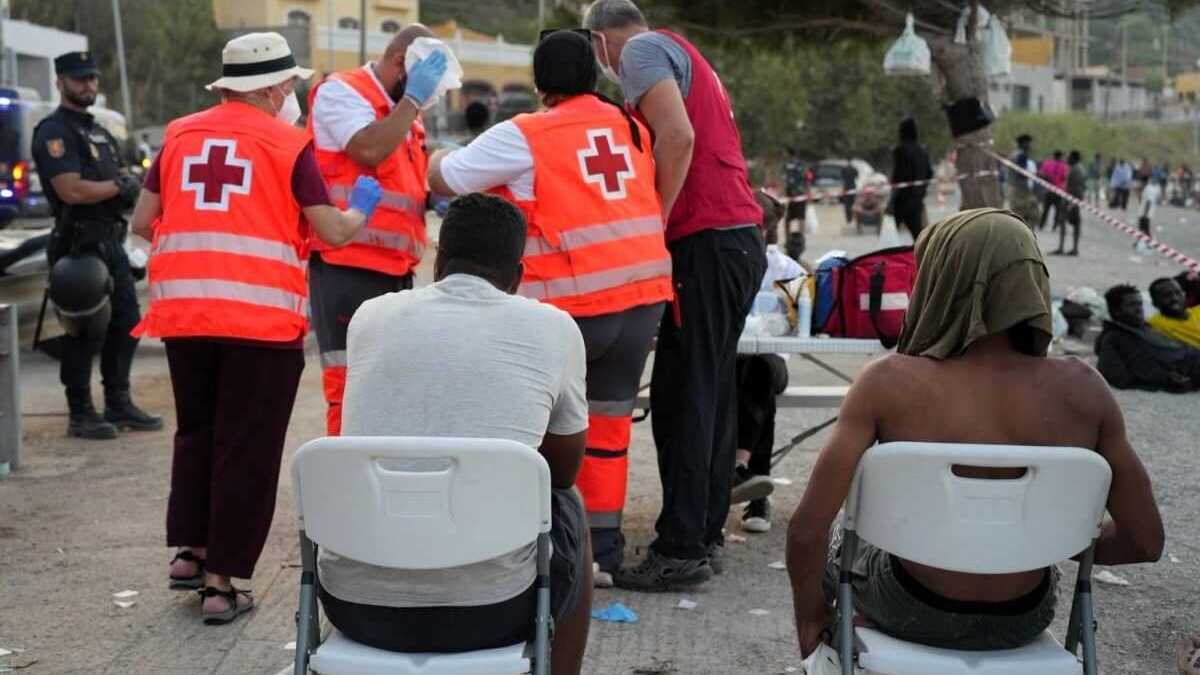
The avalanche of immigrants suffered at the end of July by the autonomous city of Ceuta, with the irregular entry of around 80,000 people, is very similar to the figures for illegal arrival of foreigners during the previous three decades in both Ceuta and Melilla, which the main official bodies estimate at between 85,000 and 100,000.
These data are contained in a report by the CEU Cefas Institute entitled Demography of the Canary Islands, Ceuta and Melilla: the porous southern border of Spain, directed by the emeritus professor of the CEU San Pablo University Joaquín Leguina and coordinated by the head of the Area of Studies and Social Analysis of CEU Cefas, Alejandro Macarrón.
For its preparation, official figures were collected from the National Institute of Statistics (INE), Eurostat, the Ministers of the Interior and Health and the United Nations, among other official sources.
According to the report, since 1995 more than 350,000 irregular immigrants have arrived in Spain through the Canary Islands, Ceuta and Melilla. The breakdown gives 270,218 people to the African archipelago, of which more than half correspond between 2021 and 2025. In the case of Ceuta and Melilla, where entries are mainly by land, the study estimates the range between 85,000 and 100,000 irregular arrivals in the same period.
This amount is quite similar to the around 80,000 people who are estimated to have arrived in Ceuta on 30 and 31 July in a large avalanche of immigrants who crossed the border irregularly. Of these, many returned to Morocco in the following days, but it is estimated that more than 8,000 remain in the autonomous city.
The report by the CEU Cefas Institute, collected by Servimedia, concludes that while the archipelago already depends on immigration to sustain its population, the two autonomous cities maintain the youngest populations in Spain due to the weight of the population of Moroccan origin.
In fact, it assures that the borders of Ceuta and Melilla «have been subject for decades to the attempt of illegal transfer from Morocco, often successful, by large contingents of Africans, Moroccans and sub-Saharan Africans«. In addition, it expressly speaks of some «episodes of a violent nature against the Spanish security forces, or with the character of an invasion promoted by Morocco», such as those that occurred in Ceuta in May 2021 and the recent one in 2026.
«The magnitude of these arrivals is very high, taking into account that both Ceuta and Melilla have between 85,000 and 90,000 inhabitants. In proportional terms, on a national scale it would be equivalent to Spain’s borders having been crossed by 20 or 25 million people. And this despite the erection of high fences, which in certain periods had sharp elements (the razor wire), in contrast to the minimal physical barriers that existed in 1975, when our borders in Ceuta and Melilla – and throughout Spain – were respected,» the study adds.
The pages of the document also refer to the fact that Ceuta and Melilla have the lowest average ages «in the country», with 39.26 and 37.66 years, respectively, and «maintain a positive natural balance«, with more births than deaths, according to Macarrón.
Likewise, until 2025, more than 86% of the foreign-born population residing in both cities came from Morocco, because the population of Moroccan-Muslim origin «could already be the majority among children and young people». According to the study, names of Arabic origin represent 81.1% of the twenty most frequent male names among those born between 2020 and 2024 in Ceuta and exceed 90% in Melilla.