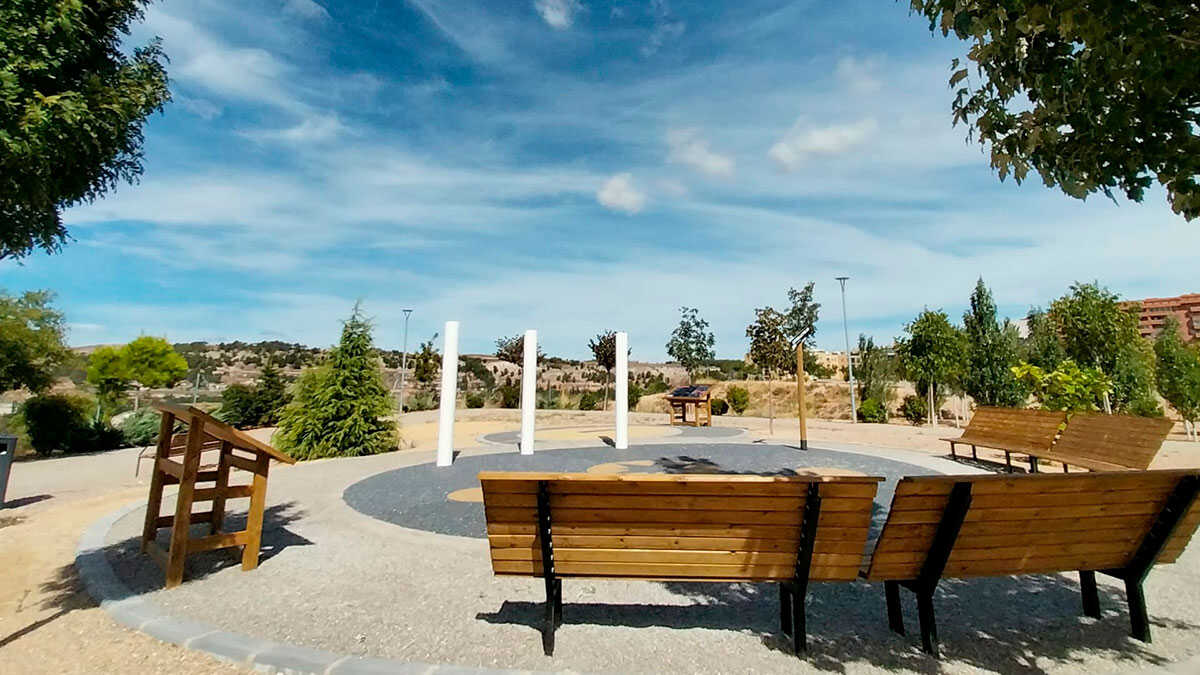
Teruel will look at the sky again just 16 days after the total solar eclipse that aroused enormous expectation in much of España. The next astronomical appointment will arrive in the early hours of August 28 with a partial eclipse of the Moon and the capital of Teruel is preparing special conditions for those who want to follow it from the Astronomical Viewpoint.
The Teruel City Council will temporarily turn off the public lighting in the vicinity of this space throughout the night. The measure aims to reduce light pollution as much as possible and achieve a darker and sharper sky that facilitates observation for both astronomy enthusiasts and the general public.
The eclipse can be seen from all over Spain, although conditions will vary depending on the territory. Aragon is among the areas where the Moon will be hidden by the horizon before the partial phase ends, so the satellite will still disappear within the Earth’s shadow and partially eclipsed.
THIS IS WHAT THE LUNAR ECLIPSE OF AUGUST 28 WILL BE
LIKE
The phenomenon occurs when the Earth is located between the Sun and the Moon and casts its shadow on the satellite. Unlike the solar eclipse of August 12, this time it will be a part of the Moon that will be darkened as it passes through the Earth’s shadow.
It will be a partial eclipse, so the Moon will not be completely submerged in the darkest area of that shadow. According to data from the National Geographic Institute (IGN), it will have a magnitude of 0.93, which means that the shadow will cover a very important part of the lunar disk.
In addition, observing it does not require the necessary precautions in the event of a solar eclipse. The phenomenon can be seen directly with the naked eye and without risk to the eyes, although using binoculars or a telescope will allow the advance of the shadow to be appreciated in greater detail.
THE ASTRONOMICAL VIEWPOINT, IN THE DARK ALL NIGHT
The public lighting will be turned off throughout the night in the vicinity of the Astronomical Viewpoint of Teruel. The municipal objective is to minimize light pollution and improve the conditions from this point to follow the eclipse.
The measure also seeks to value the night sky of Teruel and make it easier for fans and the general public to come and observe the phenomenon. The City Council plans to promote several activities in this space soon.
As a reference for the eclipse schedules in Spain, in Madrid the partial phase will begin around 04.34 hours and will reach its maximum around 06.12 hours. The Moon will set at around 07.47 hours, a few minutes before the end of the partial phase, scheduled around 07.52 hours.
The best conditions in Spain will be in the west of the peninsula, the Canary Islands and Ceuta, where the Moon will set after the partial phase ends. In Aragon, as in other areas of the centre and east of the peninsula, the satellite will still be partially eclipsed and will be able to retain its characteristic reddish hue when it is very low above the horizon.