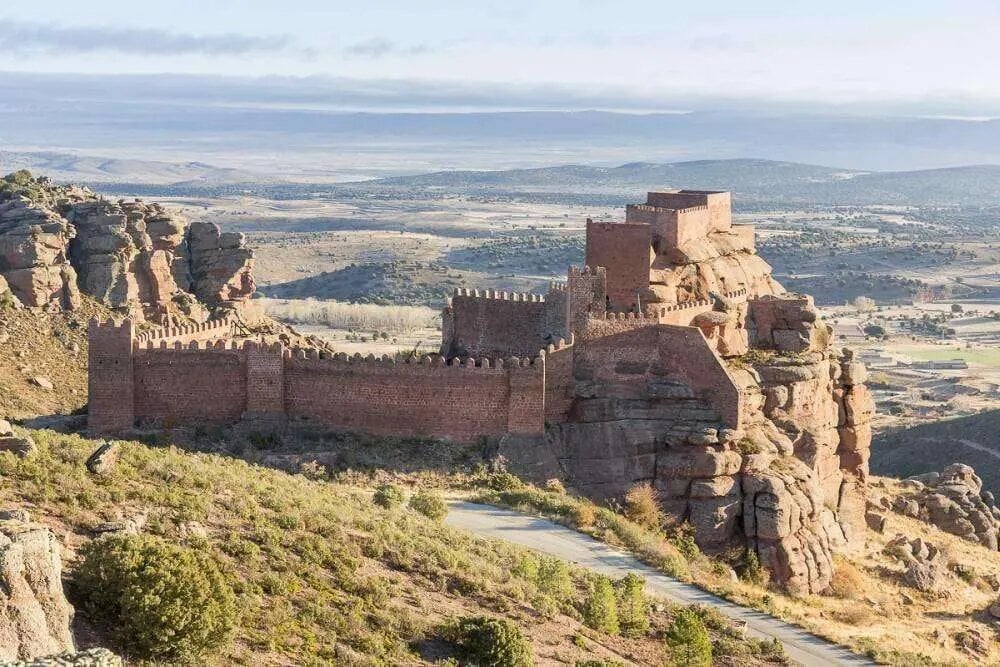
Few fortresses are nicknamed as descriptively as the red castle of Aragon. It is enough to contemplate its walls to understand the reason: the rodeno with which it was built makes the fortress seem to emerge from the mountain itself. This scenario corresponds to the castle of Peracense, located in the Jiloca region.
Its appearance is only part of its appeal. The fortress was born to guard one of the strategic passes between the ancient kingdoms of Aragon and Castile and still preserves today a good part of the structures that recall its past as a defensive enclave. Added to this is an environment of great scenic value, where the rodeno and the views over the hill of San Ginés, in the Sierra Menera, make the visit one of the most unique in the province of Teruel.
Today, touring the castle is like stepping into several centuries of history. Its three enclosures preserve a large part of the medieval structure and allow you to discover what life was like inside one of the most important fortresses in Aragon, built taking advantage of the rock itself as part of its defensive system.
HISTORY OF A FRONTIER FORTRESS
Although the hill had already been occupied in Islamic times, the current castle began to be built between the thirteenth and fourteenth centuries on that previous fortification. Its mission was to protect the border between the kingdoms of Aragon and Castile, taking advantage of a strategic enclave from which the main roads that connected both territories were controlled.
With the dynastic union of the crowns of Castile and Aragon, the fortress progressively lost its military function. It then passed into the hands of the Community of Daroca, which used it as a prison and maintained the appointment of wardens until the beginning of the eighteenth century. Already in the nineteenth century, the castle temporarily recovered its defensive character during the Carlist wars, when part of its structures were adapted again for military uses.
THE IN-BETWEEN ROOM, THE HEART OF EVERYDAY LIFE
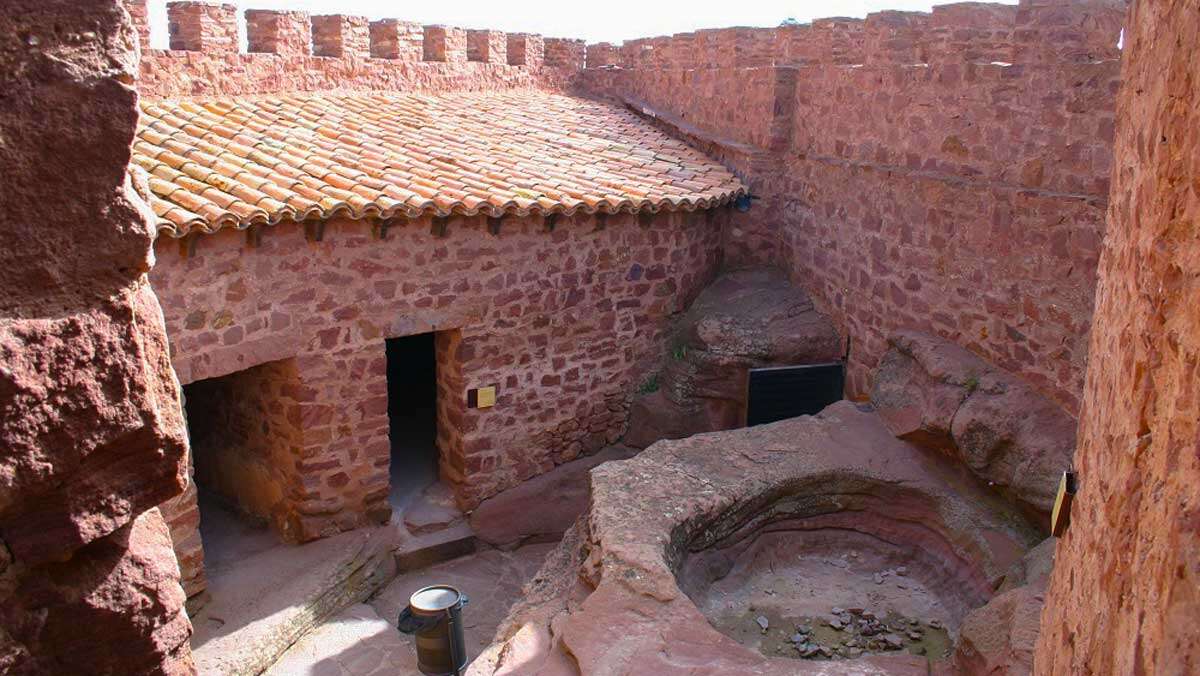
The intermediate enclosure concentrated a good part of the daily activity. Here were located the dormitories, kitchens, workshops, corrals and even the chapel. All this was protected by walls reinforced with towers, while the relief of the terrain itself acted as a natural defense in several areas.
In this space, rooms have been identified that were transformed over time. Some medieval structures, for example, were adapted to new uses in the 19th century. Nearby was a cistern that collected rainwater, a fundamental element for survival inside the fortress.

HIDDEN ACCESS AND PASSAGE-AREA
In the lower area, to the east, there were key spaces such as the prison and one of the entrances to the castle. This point connected with the old village of Los Casares through a natural passage between rocks, later reinforced with defensive structures and a small gate or postern to control access.
At the top is the upper enclosure, the most protected and difficult area to conquer. From here the entire environment was dominated and the main rooms were concentrated, including the space for the warden.
WATER, RESISTANCE, AND DEFENSE
The upper enclosure was prepared to withstand long periods of siege. It had several cisterns excavated in the rock to ensure the supply of water, as well as spaces for storage and defense.
During the 19th century, some areas of the castle were refurbished in the context of the Carlist wars, the last stage in which the fortress returned to active military use.
HOW TO GET TO THE CASTLE OF PERACENSE
The castle of Peracense is located in the heart of the Sierra Menera (Teruel) and is accessible by car from the main Aragonese cities.
- . From Zaragoza: approximately 1 hour and 50 minutes (about 150 km), along the A-23 until it joins the N-211 in the direction of Monreal del Campo.
- . From Huesca: around 2 hours and 30 minutes (about 190 km), passing through Zaragoza and following the same route.
- . From Teruel: about 70 km (approx. 1 hour), take the N-234 and then the N-211.
Once in the municipality, the castle is signposted and has parking nearby. The final access is made on foot in a few minutes.
![[EN] The red castle of Teruel that seems to emerge from the mountain and is one of the most unique in Aragon](http://www.disenoaragon.es/wp-content/uploads/2026/08/2026082610405548366-150x150.jpg)
![[EN] The red castle of Teruel that seems to emerge from the mountain and is one of the most unique in Aragon](http://www.disenoaragon.es/wp-content/uploads/2026/08/2026052513421437124-150x150.jpg)