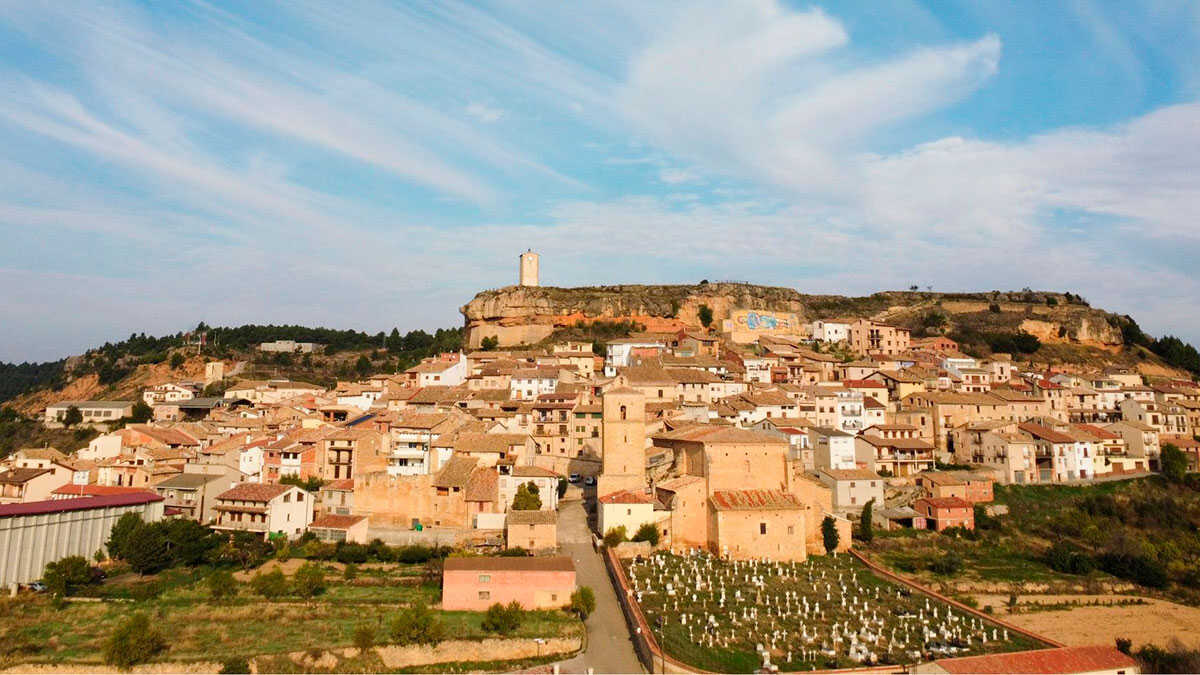
There are small villages scattered around Aragón that many do not know and that, however, keep among their streets numerous stories and a cultural heritage worth discovering. This is the case of Monroyo, a municipality of just 300 inhabitants located in the Matarraña region, which surprises with the richness of its history and heritage.
Inside, the exploits of one of the most famous kings of Aragon, Alfonso I the Battler, are recounted, and the traces of more recent events that profoundly marked our country, such as the Civil War, are also preserved. Monroyo is, without a doubt, a town closely linked to history, and this is reflected in its rich heritage.
THE LEGEND OF THE DISAPPEARED CASTLE OF MONROYO
Although it is known that in the past there was a castle, it ended up disappearing, and one of the legends of Monroyo is preserved around its disappearance. According to tradition, its stones were reused to rebuild the town after the various fires it suffered throughout its history, including the one in 1705.
However, the most devastating episode took place in 1839, when the troops of the Carlist general Llagostera set fire to a large part of the urban area. This event left a deep mark on the town and earned its inhabitants the nickname «sucarrats», which refers to those who were burned.
There are hardly any remains of the old castle. At present, the so-called bassa del castell, where the water tanks are located, is preserved, as well as a cistern excavated in the rock and some vestiges of the base of the wall in the northern area. Today, in the place where the fortress once stood, stands the Monroyo clock tower.
LA CÁRCEL AHORA AYUNTAMIENTO DEL PUEBLO
The building that currently houses the Monroyo City Council has a peculiar history, to say the least, since in the past it also served as a prison. Its construction was carried out in several stages: the first dates from 1588 and, six years later, an extension was made with lower quality materials. Subsequently, in 1781, a major reform was undertaken on its main floor.
The old prison is made up of three different spaces. The first room was used as the jailer’s home, while the other two functioned as dungeons. It is located next to the fish market and can currently be visited freely throughout the year.
PARISH CHURCH: CENTURIES OF ART
Its church, dedicated to Our Lady of the Assumption, is defined as «a living testimony of the architectural evolution» of Monroyo. The building that we see today is the result of a Gothic-style reform carried out on a previous construction from the thirteenth century. This transformation took place during the sixteenth century, when the façade was modified and new elements were incorporated that enriched the architectural complex.
The most curious thing about this church is its location, since, unlike usual, it is not in the highest part of the town, but in a lower area. This is because there was previously another temple in the upper part of Monroyo. It was in 1287 when the church that the neighbors know today was built, although its current appearance is the result of subsequent reforms.
In addition, one of the things that enrich the visit to the village is what is inside: several pieces of great artistic and historical interest. Among them is an organ from 1887, recently restored and built by Francisco Zurita in the nearby town of Belmonte. A Romanesque-style baptismal font also stands out, carved from a single piece of stone. The complex is completed with the mural paintings made by the artist Fornos in 1954 and a wooden carving of Our Lady of the Assumption, to whom the temple is dedicated.