Long before the arrival of the electric tram, Zaragoza already had a type of vehicle that would be unusual today: fully open trams known as planters.
These vehicles circulated in the city at the time when trams were still animal-drawn and moved by mules. Their open design differentiated them from closed cars and made them an alternative especially linked to the months of good weather.
In some of the spaces through which the tram currently circulates again, such as the surroundings of the Paseo de la Independencia, these vehicles already traveled more than a century ago.
The planters are thus part of the early years of the history of the Zaragoza tramway, before its electrification, and show the extent to which the city’s public transport has changed from those first mule-drawn vehicles to today’s trams.

THE PLANTERS ARRIVED WITH THE FIRST TRAMS
The first line, that of the Bajo Aragón, entered service on October 19, 1885, coinciding with the celebration of the II Aragonese Exhibition. It connected the Plaza de la Constitución (the current Plaza de España) with the Cappa station, on the Alcañiz road.

From then on, the network was completed in stages. The Torrero branch opened on September 20, 1886, the Arrabal branch in March 1887 and the Circunvalación branch in June of the same year. Among the rolling stock of these lines there were also planters: wagons with open sides, without the closed bodywork of the rest of the trams.
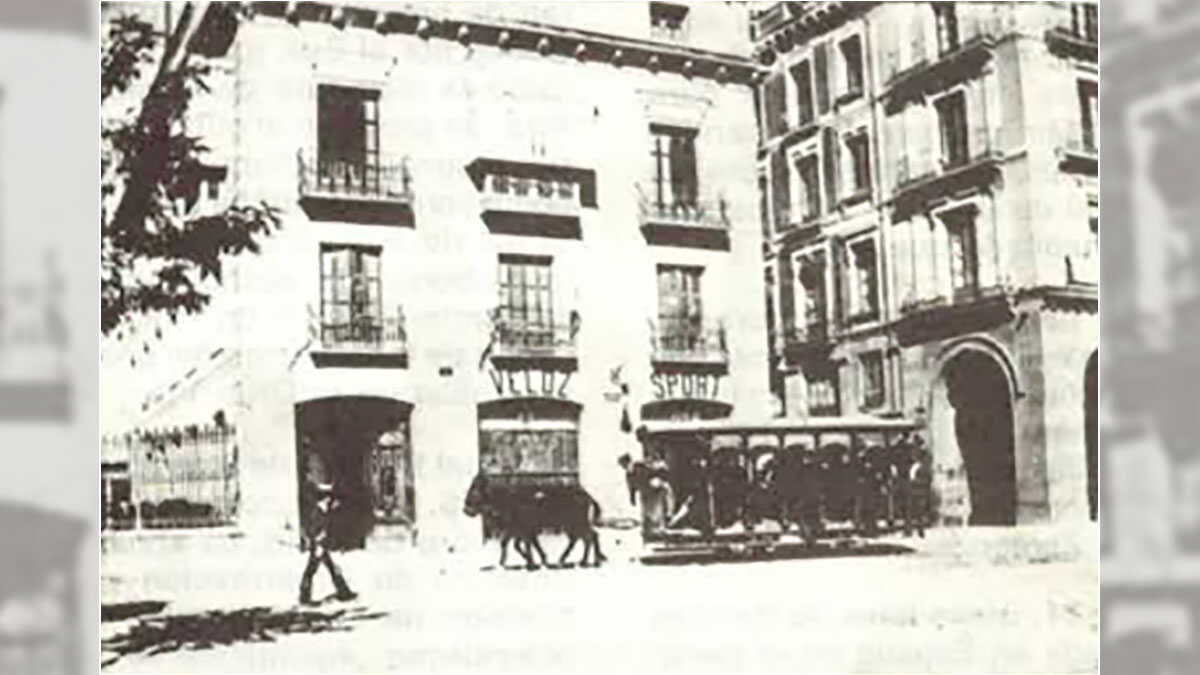
The Torrero line reached the area of the so-called Torrero Beach, a bathing and recreation space linked to the Imperial Canal of Aragon and one of the city’s summer leisure places, and came to have five planters. A photograph taken around 1890 shows one of those planters walking through the old Salón de Santa Engracia (today Paseo Independencia) in the direction of Torrero. The image allows us to understand why those open cars made so much sense during the summer months, they connected the city centre with one of its main summer leisure spaces.

The idea of letting air in to make a journey in summer bearable was not born with electrification, it accompanied the Zaragoza tram from its early years. And it was not an exclusively local rarity either, Madrid and Barcelona had similar solutions around the same time.
ELECTRIFICATION DIDN’T END WITH THEM EITHER
The leap to electric traction took more than a decade to arrive. The works were authorised as early as 1898, but the project did not go ahead until, in 1902, a group of Zaragoza businessmen led by the Escoriaza and Paraíso families took the reins of electrification.
The first tests of the new system were carried out on October 8 of that year, and on the 10th the Torrero line became the first in the city to run with electric traction, with material manufactured in Zaragoza by Carde and Escoriaza.

Electrification did not end the planters either. The old open cars remained part of the system and some of the old animal-drawn vehicles were repurposed as trailers behind the new electric trams. The concept that had circulated with the mules was transferred, almost unchanged, to the new traction system.
A photograph from 1925 shows precisely one of these compositions in the Plaza de la Constitución.

THE WINTER THAT DEFEATED THEM
The same open full-backs that made a journey in August pleasant were unsustainable in January. In 1908, the planters of the 25-28 series were no longer suitable for winters and many of them were transformed into enclosed cars. The planter did not disappear all at once: the company kept the vehicles, but had to give up precisely what had given them a name and meaning, going open. They had survived mules and electricity, but not winter.
Today the modern tram runs through our streets with the windows closed and the air conditioning. Machines and the way we move around have changed, but the question is still surprisingly similar to the one Zaragoza had 140 years ago: how to cross the city in summer without roasting on the way. At the time, the answer was to remove the walls of the tram.
![[EN] This was the curious tram without walls that circulated in Zaragoza 140 years ago](http://www.disenoaragon.es/wp-content/uploads/2026/08/2026011719533460747-150x150.jpg)
![[EN] This was the curious tram without walls that circulated in Zaragoza 140 years ago](http://www.disenoaragon.es/wp-content/uploads/2026/08/2025092011374770989-150x150.jpg)