The villages of Aragón hide charming corners and, sometimes, really curious names. But not everyone can say that they are, literally, «beautiful». And it is not just an adjective: it is Bello, a small Teruel municipality of just 237 inhabitants that surprises with a unique natural environment in Europe.
In fact, this prehistoric town located in the region of Jiloca, is surrounded by one of the largest and most important salt lagoons in the Old Continent. And, of course, this town of Teruel lives up to its name.
BELLO, THE TOWN OF TERUEL WITH AN IMMENSE SALTY LAGOON
If there is something that makes Bello unique, beyond its name, it is the Laguna de Gallocanta. Located at an altitude of more than 1,000 metres, it is seven kilometres long, two kilometres wide and two metres deep, making it the largest salt lake in Western Europe.
But not everything is water, as the Gallocanta Lagoon Managed Nature Reserve has one of the most unique ecosystems in Europe. Every year, more than 60,000 cranes cross the skies during their migrations, giving a spectacle that is difficult to forget.

It is curious that cranes choose to spend the winter one of the coldest places in Spain, but that’s right: as they come from the north, any trip to the south is heat gain. In the municipality of Bello there are exceptional points to admire its morning flights, which attract fans from all over Europe.
The birds that spend the winter in Gallocanta, the Sotonera or Doñana arrive from Finland, the Baltic republics, Poland, Germany and the Czech Republic. Those who do not opt for Spain, their favourite destination along with Morocco, head to the south of France, Portugal, Algeria, Tunisia or Libya.
For those who want more than just looking, the Gallocanta Lagoon Interpretation Centre offers interactive exhibits that explain the details of this unique ecosystem.
In addition, the Mirador El Silo, at the entrance to the town, is the place par excellence to stay in Bello and the entire surrounding area. It is a restaurant and hotel integrated into one of the classic buildings of the old National Silo Network, conditioned for the practice of hospitality. Although it is not currently operational for repairs, it has a small observatory on the roof, a space dedicated to ornithology and bicycle rental.
WHAT TO SEE AND DO IN BELLO
Beyond the lagoon, Bello surprises with its history. The origin of the village dates back to the Bronze Age and its name comes from the Celtiberian tribe of the Belos. For centuries, it even gave its own region its name.
Among the places worth visiting are the Hermit’s House, the Trinity Hermitage and the remains of an ancient Celtiberian wall, visible traces of a past of great relevance. The hermitage is based on the old Humilladero de Bello, from the seventeenth century, and has a triptych altarpiece dedicated to the Trinity and the Saints John, made by Juan Vicente Brun in 1621.
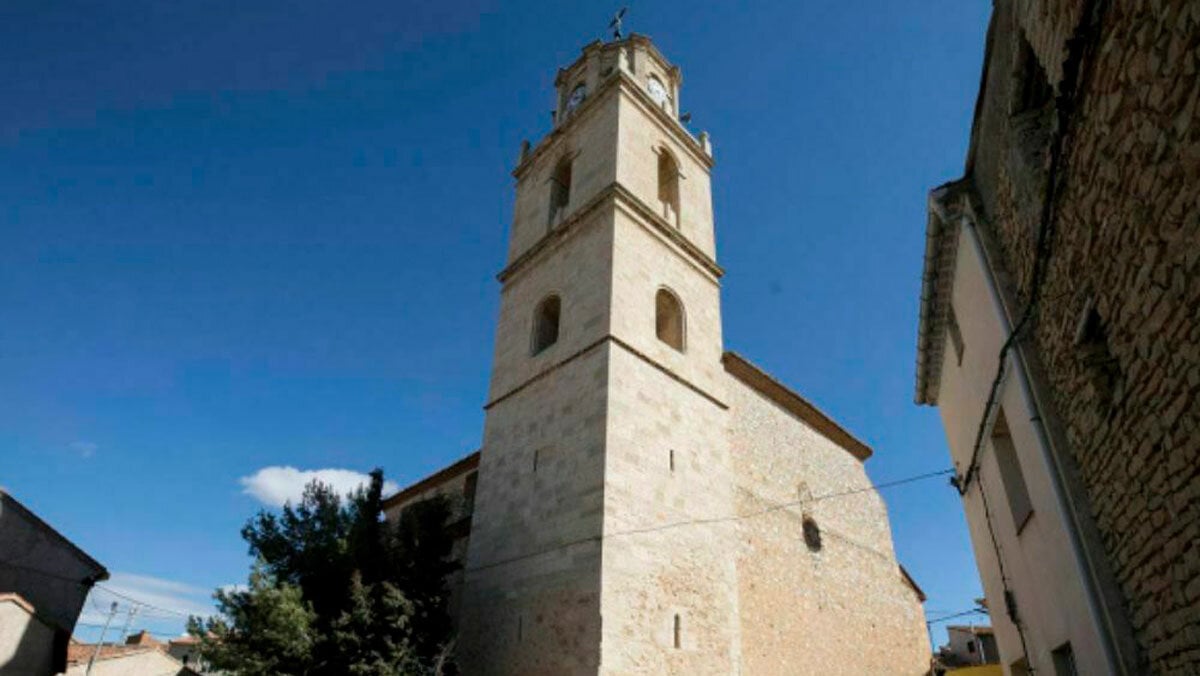
Right next door is the old house of the Hermit, a masonry building with a gabled roof. You can also visit the Church of the Nativity, the parish church of the town, a Gothic-Renaissance temple completed at the end of the sixteenth century, made of ashlar and masonry, with a single nave, with three sections, side chapels between the buttresses and a polygonal chevet.
The beauty of Bello’s landscapes has also attracted the attention of cinema: part of the film El páramo, by David Casademunt, was shot here. The film came to be in first place of the most watched foreign language films on Netflix.
Lovers of hiking have several routes that start from Bello and that allow you to explore both the surroundings of the lagoon and the agricultural and natural landscapes that surround the town. In any season, the walk becomes an experience that mixes history, nature and silence.
HOW TO GET TO BELLO, IN TERUEL
Getting to Bello is simple and quick. From the city of Teruel, the journey by car takes about 1 hour on the A-23. From Zaragoza, the journey takes approximately 1 hour and 25 minutes, also on the same route.
A close, accessible and perfect destination for those looking for authentic rural tourism, away from the crowds and in full connection with nature.
Bello lives up to his name. And although it does not always appear in the most mediatic lists of Aragonese towns, it is certainly Bello as its name promises.
We want to know your opinion
Comment on the news on our Networks: Facebook, Instagram, TikTok, X, Youtube, Linkedin…
Sign up for free to our < href="https://www.aragondigital.es/user/register/?target=newsletter" target="_blank">newsletter and take us on your mobile by downloading the < href="https://play.google.com/store/apps/details?id=com.opennemas.aragondigital" target="_blank">App or in the < channel to href="https://www.whatsapp.com/channel/0029VaCzzD5It5rxtjfrj71U" target="_blank">WhatsApp.
And for direct contact by email with our journalists: redaccion@aragondigital.es
Because you are also Aragón Digital