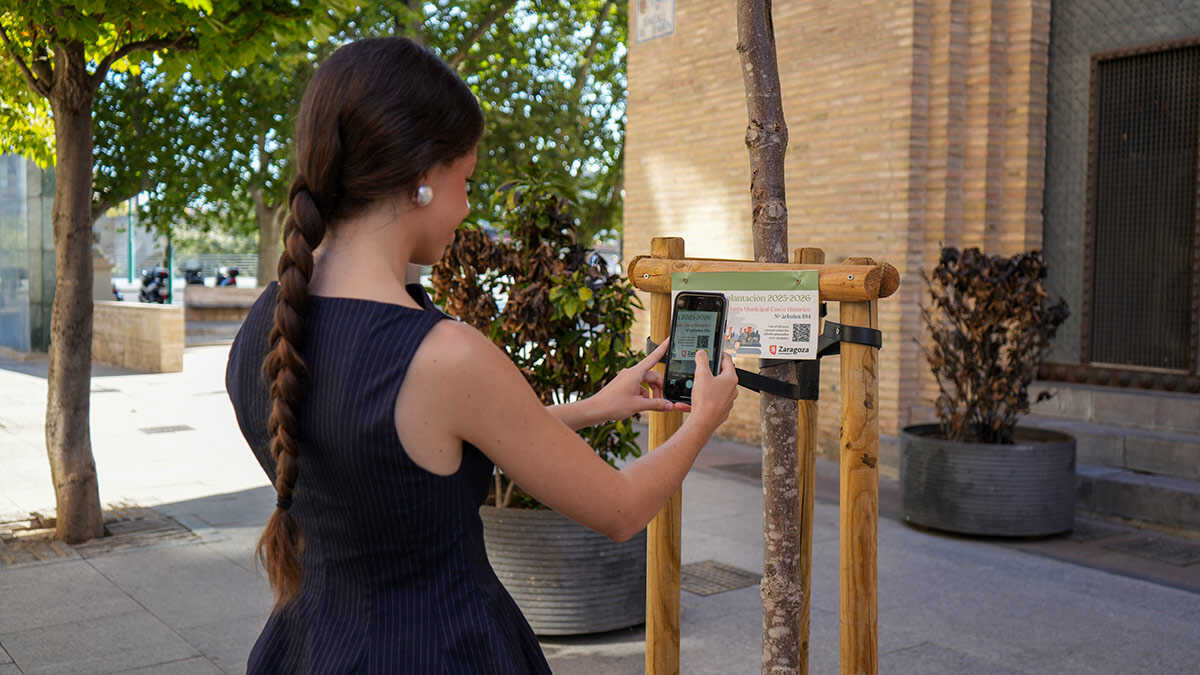
Perhaps it has gone unnoticed among the traffic, the terraces, the parked cars and the coming and going of pedestrians. But it is enough to look a little at the new trees that are appearing in the streets of the Aragonese capital to discover a small detail that was not there until now: a QR code. A kind of gateway to the history of each specimen that the Zaragoza City Council is planting in the tree pits that had been empty for a long time.
The mayor of Zaragoza, Natalia Chueca, has shown this novelty in a video published on her social networks. The operation is as simple as pointing the mobile camera at the code. By doing so, each Zaragoza resident can know what species they have in front of them, when it was planted and what role it plays within the municipal plan for the replacement of trees. A way of putting a name and context to those trees that, for the moment, are just small specimens that are beginning to make a place for themselves in the streets.
And not only will it be possible to consult the information of the trees that are already planted. The municipal website also allows you to take a look at a map with the planned actions, organized by districts and neighborhoods, to know where the next plantations are going to take place. The 2026-2027 campaign includes about 3,400 new trees, with the aim of occupying all the empty tree pits in which it is technically possible to plant.

EACH LOCATION IS STUDIED ACCORDING TO EACH SPECIES
Behind this small label there is, in fact, a change in the way the city’s trees are managed. Zaragoza has almost 172,000 trees and the City Council assures that, for the first time, it is planning each replacement individually. That means studying each location and choosing the species that best suits its characteristics, also seeking to make its maintenance more efficient.
![[EN] Zaragoza’s trees now have QR: what is it and what is this curious idea for?](http://www.disenoaragon.es/wp-content/uploads/2026/08/2025020714022027874-150x150.jpg)
![[EN] Zaragoza’s trees now have QR: what is it and what is this curious idea for?](http://www.disenoaragon.es/wp-content/uploads/2026/08/2026082009582223933-150x150.jpg)