There are places in the province of Zaragoza where it is enough to move a few steps away from the last houses for the landscape to change completely. This happens in Aldehuela de Liestos, a small town in Campo de Daroca where one of its greatest treasures remains hidden underground, in the middle of the Valgrande ravine.
There is the Gruta del Romeral, a cavity about 90 meters long that allows you to walk among stalactites, stalagmites, columns and lava flows. It is equipped and illuminated for visits and its low difficulty makes it an interesting gateway to the world of caving.
About 120 kilometres from Zaragoza, Aldehuela de Liestos completes the getaway with an environment marked by the Piedra River. Its gorges, its paths and an urban center that preserves several testimonies of centuries of history mean that the visit can extend far beyond the cave.
LA GRUTA DEL ROMERAL, UN VIAJE BAJO TIERRA
The Grotto del Romeral is made up of materials from the Upper Cretaceous and has three large rooms. The slow work of the water on the rock has drawn inside the characteristic shapes that turn the karst cavities into authentic underground landscapes.

The entrance incorporates a vertical shaft of about seven meters that adds a small adventure component to the experience. The entire route can take about two hours and is designed as an accessible activity for those who want to have a first contact with caving.
To get to it, you have to leave from Aldehuela de Liestos following a path signposted along Calle de la Fuente and walk approximately one kilometre. During the journey, aromatic and medicinal plants, including sage, appear before reaching the cavity.
Before travelling, it is advisable to check the updated conditions of access and booking with the Gallocanta Tourist Office, which is in charge of providing information on visits.
LAS HOCES DEL RÍO PIEDRA, A CANYON BETWEEN CORTADOS
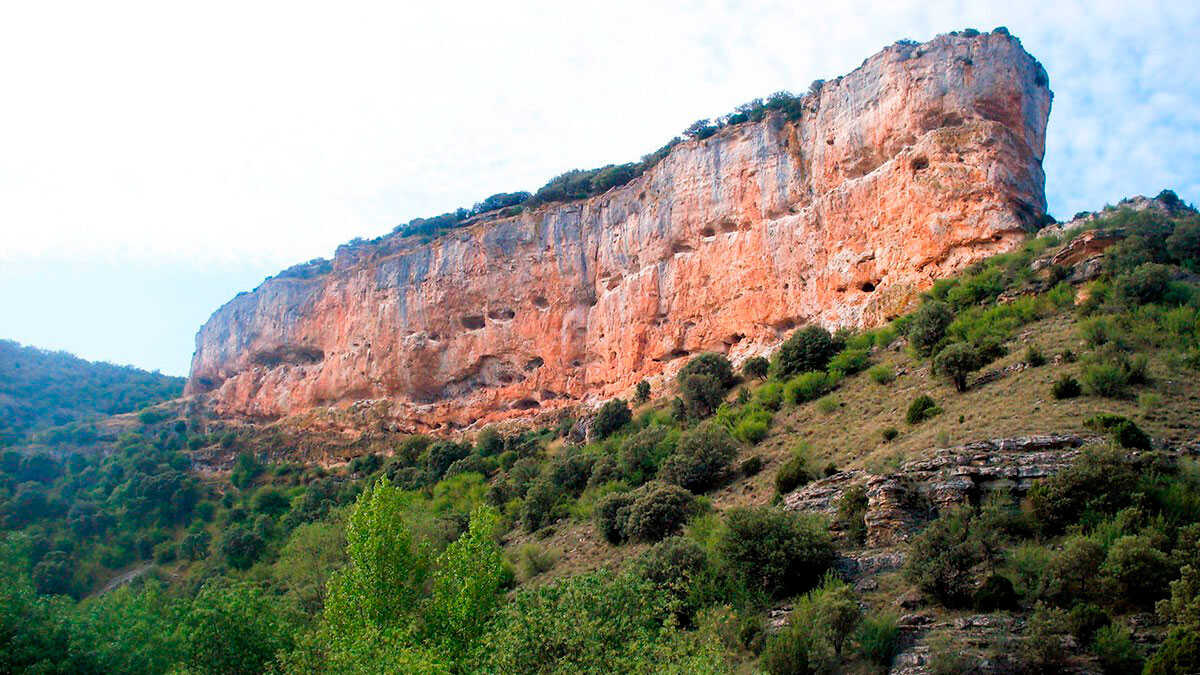
Back on the surface appears the other great natural attraction of Aldehuela de Liestos. The Hoces del Río Piedra form an abrupt spot in which large vertical cuts, rocks and the bottom of the canyon are alternated by the course of the water.
The area stands out for its ecosystems of rocks and river groves and is recognised for its natural interest within the European network of protected areas. It is also a territory of rock-dwelling birds, so during a walk it is possible to look up and discover the griffon vulture flying over the walls.

Hiking, climbing and bird watching are some of the activities that find a privileged setting here. In addition, the GR-24, a long-distance path that crosses the regions of Campo de Daroca and Calatayud, passes through the municipality.
The river is, precisely, the common thread of this part of the province. The Piedra River, which excavates these gorges, is the same river course that gives its name and shape, kilometers later, to the well-known surroundings of the Monasterio de Piedra.
A PEOPLE LINKED FOR CENTURIES TO THE STONE MONASTERY
The history of Aldehuela de Liestos is closely related to this Cistercian monastery, to which it belonged until 1269. Later, the Liñán family served as the lady of the place until the nineteenth century and left their mark on some of the most outstanding buildings in the municipality.
Their heraldic coats of arms can still be seen on the facades of the Town Hall and the parish church of the Assumption. Inside the temple there are Baroque altarpieces and a silver chalice with a circular foot dated to the end of the fifteenth century.
The artistic heritage also has a curiosity especially linked to Aragon: two canvases preserved in the town are attributed to Francisco Bayeu, a painter from Zaragoza and brother-in-law of Francisco de Goya.
In addition to these buildings, there are the hermitages of Santa Bárbara, San Roque-San Cristóbal and the Virgen de Guialguerrero, as well as several peirones and the uninhabited Celtiberian area of El Castillo, another of the points of interest in the municipality.
HOW TO GET TO ALDEHUELA DE LIESTOS FROM ZARAGOZA
Aldehuela de Liestos is located in the region of Campo de Daroca, approximately 120 kilometres from Zaragoza. From the Aragonese capital it can be reached by road using the A-23 and then continuing along the road network that leads to the municipality.
Those who intend to travel the Hoces del Río Piedra can park at the beginning of the hiking route. Along the route there are different points from which to contemplate the canyon and the cliffs that accompany the river.
With the Gruta del Romeral as a great surprise underground and the Hoces del Río Piedra as the protagonist on the surface, Aldehuela de Liestos brings together nature, hiking, heritage and rural tourism in one of the small villages of Zaragoza that still allow you to discover the Campo de Daroca region away from the busiest destinations.