There are just a few hours left for a new eclipse to amaze Aragón. The Community was one of the privileged settings to contemplate the spectacular total eclipse of the Sun on August 12 and, with those images still recent, many will want to take advantage of a new opportunity to look at the sky. This time the appointment will be in the early hours of the morning and the protagonist will be the Moon. But what will the eclipse of this August 28 look like from Zaragoza, Huesca and <a href=»/teruel/»>Teruel and at what time will we have to look at the sky?
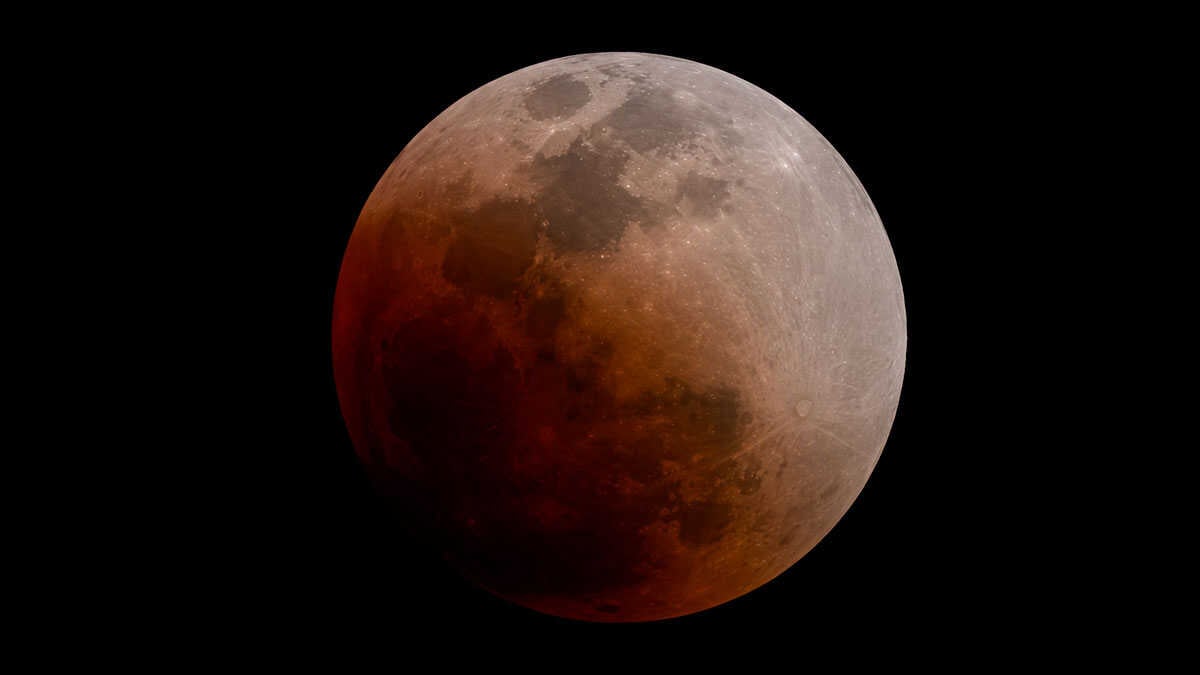
On this occasion, there will be a partial eclipse of the Moon during the early hours of Friday, August 28. This phenomenon occurs when the Earth is located between the Sun and the Moon and casts its shadow on our satellite. As it is a partial eclipse, the Moon will not be completely submerged in the darkest part of the Earth’s shadow, although the magnitude will be around 0.92, so a large part of the lunar disk will become darker.
In addition, during the phenomenon the Moon may acquire reddish tones. This characteristic color is produced because part of the Sun’s light passes through the Earth’s atmosphere before reaching the lunar surface. The bluish tones scatter more easily, while the reddish tones manage to pass through the atmosphere and reach our satellite.
The partial eclipse will begin at 04.34 am and will reach its maximum at 06.12 am, when the Moon will present its most spectacular appearance. The partial phase will continue afterwards, but in Aragon there will be an important condition: the Moon will set before the eclipse ends at 07.52 am. For this reason, the last phases will not be able to be seen from the Community.
HOW WILL THE LUNAR ECLIPSE BE SEEN IN ZARAGOZA, HUESCA AND TERUEL AND AT WHAT TIME
In Zaragoza, the partial eclipse will begin at 04.34 hours and will reach its maximum at 06.12 hours, when the Moon will be at an approximate elevation of 12.8 degrees. From that moment on, it will continue to approach the horizon while it is still eclipsed. The Moon will set at 07.33 hours, so from the Aragonese capital it will not be possible to contemplate the end of the partial phase, scheduled for 07.52 hours. In the central moments, a large part of the lunar surface will appear darkened and a reddish hue can be seen.
In Huesca, the schedules will be very similar. The eclipse will also begin at 04.34 hours and will reach its maximum at 06.12 hours, with the Moon located at about 12.2 degrees of elevation. The main difference will be in the time of its setting: in the capital of Huesca, the Moon will disappear over the horizon around 07.31 hours, still partially eclipsed. It will be, of the three Aragonese capitals, where it will be lost from sight first.
In Teruel, there will be a few more minutes to enjoy the phenomenon. After starting the partial phase at 04.34 hours, the maximum will arrive at 06.12 hours, when the Moon will be about 13.5 degrees above the horizon. It will then lose height until it sets around 07.36 hours. The complete end of the eclipse will not be visible here either, but Teruel will be of the three Aragonese capitals that will have a few more minutes of observation before the Moon disappears.
TIPS FOR VIEWING THE AUGUST 28 LUNAR ECLIPSE
Unlike what happened with the total solar eclipse on August 12, this time it will not be necessary to use special glasses or filters to protect the eyes. Lunar eclipses can be observed directly and safely with the naked eye. Those who want to appreciate in greater detail the advance of the Earth’s shadow on the surface of the Moon can resort to binoculars or telescopes.
The choice of place will be especially important. As the eclipse progresses, the Moon will lose height and get closer to the horizon, so it will be advisable to look for a point with good visibility to the west and southwest. An open space or an elevated area, without buildings, trees, mountains or other obstacles, will allow you to follow the phenomenon for longer before our satellite disappears.
It will also be advisable to stay away from areas with a lot of light pollution to better appreciate the spectacle. And one last factor that does not depend on astronomy will have to be taken into account: the clouds. If the sky is good, this time there will be no need for eclipse glasses or major preparations: it will be enough to set the alarm clock, look for a clear horizon and look at the sky again just 16 days after the historic total solar eclipse on August 12.