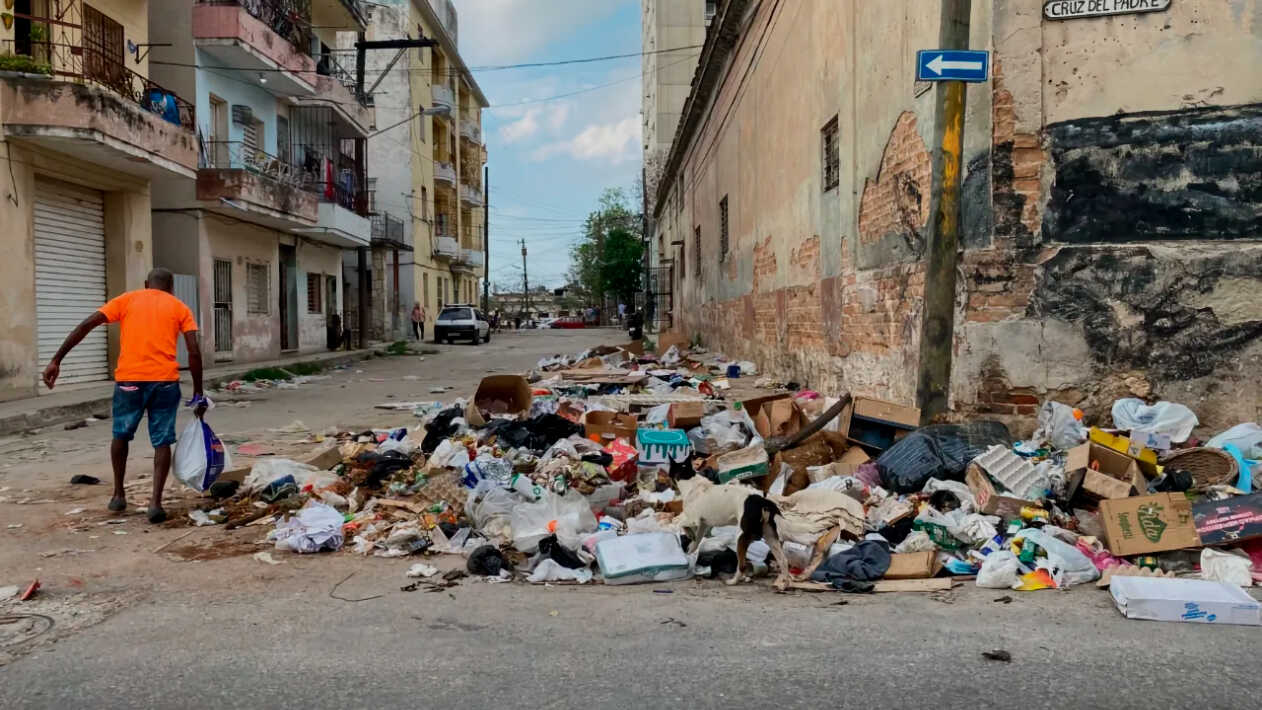
The socioeconomic situation in Cuba continues to deteriorate. A new study indicates that 94% of the population lives in extreme poverty, while 95% of those surveyed suspend the government’s economic and social management, three points more than a year ago. Only 3% support the management of Miguel Díaz-Canel and Manuel Marrero.
The economy of Cuban households appears as one of the main focuses of concern. 68% of the participants declare a family income of less than 20,000 Cuban pesos per year, which at today’s exchange rate would be about 712 euros, while 63% say they have difficulties even acquiring essential products. According to the study, nine out of ten households are at economic levels that barely allow them to cover basic needs.
BLACKOUTS AND LACK OF FOOD, AMONG THE MAIN PROBLEMS
Diet also reflects these difficulties. Eight out of ten interviewees say they have had to do without some food during the day due to lack of money or food shortages, compared to seven out of ten in the previous edition. Among the country’s main problems, blackouts lead the responses with 70%, followed by the food crisis, the cost of living, the health and medicines and low wages.
The report also shows a sharp deterioration in infrastructures and public services. 95% consider that their general condition is fair or poor, with the electricity grid as the worst rated area. Garbage collection, internet and telephone, water and sewage systems, hospitals and health centres and roads also receive negative evaluations. In terms of housing, almost half of those surveyed say they live in properties that need repairs.
LITTLE CONFIDENCE IN ECONOMIC MEASURES
Most also do not trust that the latest economic measures announced by the Cuban government will allow the situation to be reversed. 84% believe that they will not improve the economy, compared to 6% who expect positive effects. In contrast, 50% believe that in the next six months there could be some important and favorable change for the population, while 33% do not share that expectation.
Regarding the future of the country, 76% of those surveyed are committed to both political and economic changes, comparedto 9% who only want economic transformations and 4% who only demand political changes. On education and health, 66% are in favour of public and private models coexisting, while 21% prefer that both services continue to be exclusively public.
MORE THAN 1,300 INTERVIEWS THROUGHOUT CUBA
The study is based on 1,318 interviews conducted between June 27 and July 29, 2026 in 79 municipalities in all Cuban provinces and the Island of Youth. To estimate extreme poverty, the OCDH compared the income declared by households with the dollar exchange rate and with a daily income threshold used as an international reference, a methodology with which it concludes that at least 94% of Cubans are below that level.