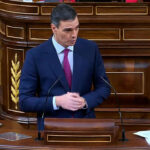
The Government will resume political activity this Tuesday with the first meeting of the Council of Ministers after the summer break. The Executive returns with a task on the table: to present the General State Budget (PGE) for 2027 and try to move forward with new public accounts for the first time since November 2022, when those for 2023 were approved, which are still extended to date.
The Executive will seek to meet the deadlines and close the legislature with updated budgets adapted to the economic reality of the country. Despite these years without new accounts, the Government has defended that Spain has continued to grow and respond to different inflationary crises and environmental impacts, such as the DANA in Valencia.
The President of the Government, Pedro Sánchez, said goodbye to the course at the end of July with the promise of presenting the 2027 Budget and the will to approve it, although for this he will need the support of the parliamentary groups. The Minister of Finance, Arcadi España, recalled this week that the Executive plans to negotiate the draft budget with the political formations during September, when activity resumes in Congress.
Spain appealed to the «responsibility» of the political groups, which with their vote will have to decide «if they want a budget» that will reflect the priorities and needs of the autonomous communities. «If they are in favor of that or they are against. That is the question they should ask,» he concluded in a statement to the media in Alicante.
The government is already finalizing «joint work» to attend these meetings with a draft of the public accounts for the next year, as Spain assured. Before sending them to Congress to begin their parliamentary processing, the Executive must approve them in the Council of Ministers.
SOME «FLAWED» ACCOUNTS FOR THE PP
The PP’s Deputy Secretary of Finance, Housing and Infrastructure, Juan Bravo, warned in July that the future draft law of the PGE 2027 will be «flawed» because «it comes with the failure to comply with the law» in the objectives of budgetary stability.
Bravo was referring to Congress’ rejection, on two occasions, of the stability objectives. The government presented the deficit path to the Lower House on July 14 and obtained 178 votes against, five abstentions and 167 votes in favor. A week later he brought the same proposal again and the parliamentary response was identical.
The PP denounced that the Executive’s procedure «did not comply with the law», because on the second occasion they should have presented new deficit targets, while the Treasury returned to those that had fallen a week earlier. On both occasions, the government proposed a total general government deficit of 1.8% in 2027, with 1.5% for the Central Government, 0.1% for the autonomous communities, 0.2% for Social Security and stability for local entities.
Public debt targets were set at 97.6% in 2027; 96.4% in 2028; and 95.3% in 2029. The spending rule stood at 4% in 2027; by 3.8% in 2028, and by 3.6% in 2029.
Bravo recalled that the Organic Law on Budgetary Stability and Financial Sustainability establishes that, if the debt targets are rejected by the Parliament, the Government must submit new ones within a maximum period of one month and submit them to a vote again. «They should have brought new ones and they have not done so,» he reproached the Government.
Although Congress overturned the path of stability, the government will go ahead with the presentation of the PGE, which will have more restrictive objectives, since those of the Medium-Term Structural Fiscal Plan (Pfemp) agreed with Brussels will be used. In them, the budget balance for the autonomous communities is established, instead of that deficit margin of 0.1%.